the approved system
work in public, without the theatre.
Pooria Arab builds software and shares the operating record. The identity feels warm, candid, and active. Shipped work always leads.
what the brand stands for
This is a builder’s operating record. Products, decisions, mistakes, and results provide the proof. Hackathons, writing, and investments show range without replacing the work.
“here’s what I’m building, and what happened next.”
say the thing plainly
Write like a candid builder speaking to another capable person. Use short sentences. Keep useful detail. Let evidence carry the claim.
sounds like us
- “I shipped the first version in a weekend.”
- “The launch failed. Here is why.”
not our voice
- “Unlock your limitless potential.”
- “World-class innovation at scale.”
one warm palette
Cream and ink do most of the work. Yellow marks one decision. Ember appears only on keyboard focus. These values are exact.
cream
page field
#fffdf7cream surface
quiet surfaces
#fff8e8ink
primary copy
#1c1a15muted ink
secondary copy
#57503ffaint ink
large secondary text
#6b6455ink line
hairline structure
#e6dcc4marker yellow
one focal decision
#ffc72cyellow hover
primary action hover
#f5b81aember
focus rings
#ff8a3d
Ink on yellow has 11.14:1 contrast. White on yellow fails. Never use yellow for body text on cream.
Aa
Instrument Serif
Display and section headings. Use regular weight, tight tracking, and short lines. The serif provides the human, editorial voice.
Aa
Poppins
Body copy, navigation, labels, and controls. Use regular or medium weight. Keep body copy at 16px with relaxed line height.
the mark stays simple
Use the lowercase wordmark for navigation and attribution. Use the square “p” mark when space is limited. The mark must remain intact.

asset files

- Keep clear space equal to one quarter of the mark’s width.
- Do not recolor, stretch, rotate, outline, or add effects.
- Do not use the retired “Pooria” logo files.
- Set the text wordmark in Instrument Serif. Keep it lowercase.
the face is a brand asset
Generated images of me keep failing the same way: a narrow chin, a heavy beard, a short forehead. That is not a prompting problem. It is a missing artefact. This section is the artefact.
Attach the casting sheet as the reference image. Never attach the decorated character sheet: a model given a multi-panel board reproduces the board layout instead of the person.
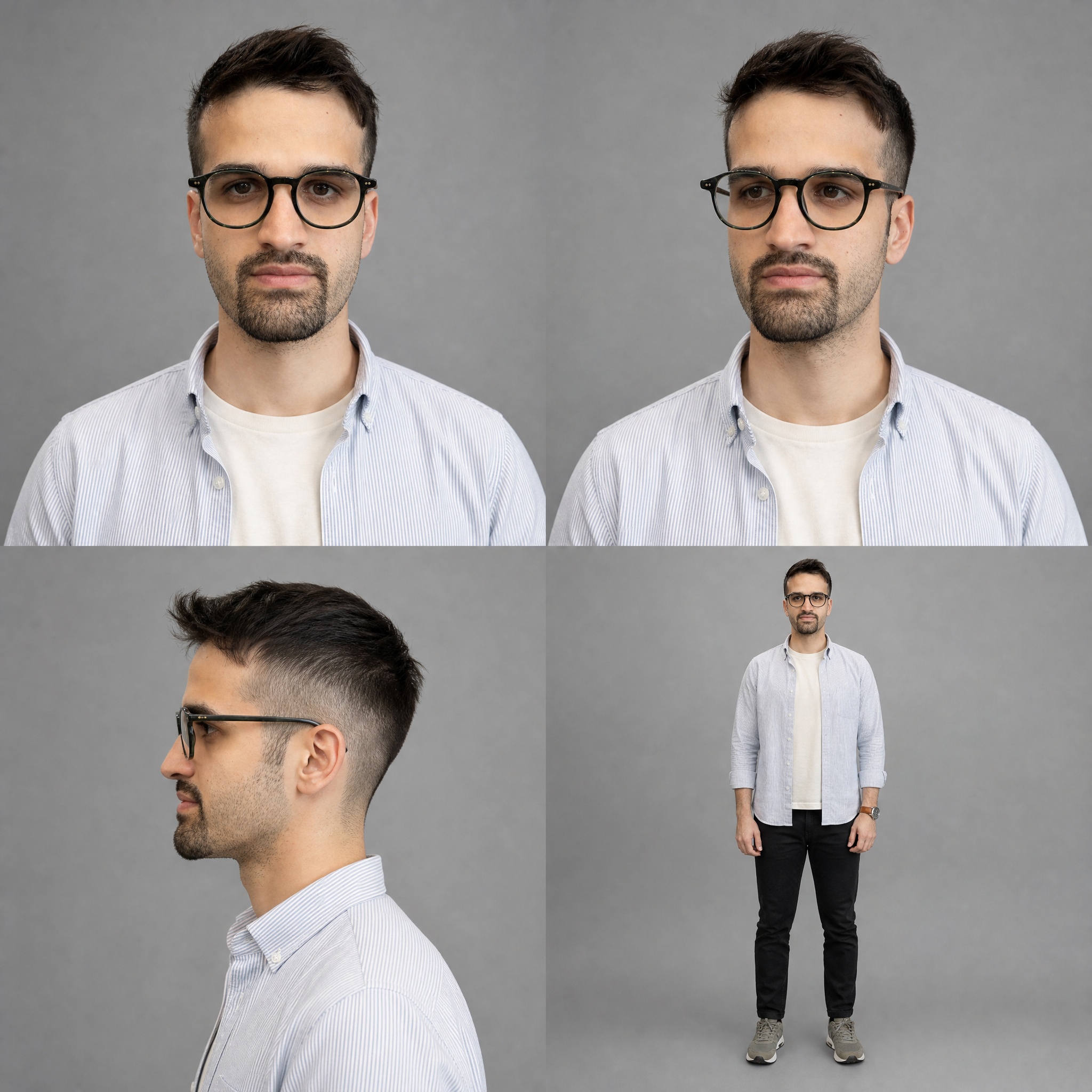
the identity preamble
Paste this ahead of any prompt. It carries the MUST and NEVER lines the likeness verifier scores, plus the named faults generated images keep repeating.
You are making an image of Pooria Arab from attached reference photographs. Hold every one of these anchors against the photographs:

Tall forehead, high hairline with slight temple recession
MUST: A tall, gently convex forehead, about 35% of face height from brow line to hairline, measured across 87 photographs. The hairline sits high and is mature, with a SLIGHT recession at each temple. It is a soft, shallow recession, not a deep widow's peak.
NEVER: A low juvenile hairline sitting close to the brows. A forehead under about 30% of face height. A deep strongly-receding M-shaped hairline.

Very short faded sides, longer textured top, worn up or forward
MUST: Dark brown, near-black, straight to slightly wavy. The sides and back are cut VERY short, a taper or skin fade tight to the skull. The top is clearly longer and textured. He wears it two ways and both are correct: swept up and back, or forward and messy with strands falling at the temples. Moderate volume, around 3 on a 5 scale.
NEVER: Long hair. Curls. Uniform length all over. A slick wet-look finish. Hair as voluminous as a pompadour.

Oval face of ordinary width, broad softly-squared chin
MUST: An oval face, longer than it is wide, with cheekbone width about 72% of chin-to-hairline height. The lower face is NOT a V. The chin is BROAD and softly squared, with real width across it, and the jaw keeps a visible angle at the back before it turns toward the chin. Cheeks are flat to slightly lean under the cheekbone, never hollowed or sunken. The face reads healthy and normally fleshed.
NEVER: A pointed or V-shaped chin. A narrow chin that tapers to a point. A smooth unbroken taper from cheekbone to chin with no jaw angle. A gaunt, sunken or hollow-cheeked face. Equally, no round or square face, no heavy wide jaw, no puffy cheeks.

Sparse cheeks, density at chin and moustache
MUST: Facial hair is always concentrated on the chin, the jaw and the moustache, and always sparse on the flat of the cheek, around 20% coverage, with skin reading through. Length runs 2-6 mm. The beard is a warmer, lighter brown than the head hair.
NEVER: A dense uniform beard with full cheek coverage. A long beard. A solid black beard matching the hair exactly.

Tall, lean, narrow-shouldered, long limbs
MUST: A tall, slim, ectomorph build. Shoulders about 2.2 head-widths across, measured over 83 photographs. A slim flat torso, long arms and legs, and a long slim neck.
NEVER: A broad, muscular, athletic or stocky build. Wide shoulders. A thick neck. A heavy chest. A short or average-height look.

Round frames, thin black metal or thick dark acetate
MUST: He owns two round pairs and both are correct: thin black metal circles with a keyhole bridge, and thicker dark acetate rounds. Lenses are round in both cases, and clear. He is bare-eyed in 39 of 90 photographs, so no glasses is also correct when a shot does not call for them.
NEVER: Square or rectangular frames. Aviators. Half-rim or rimless. Tinted lenses when clear glasses are called for.

Medium-length straight nose, not oversized
MUST: A straight nose of MEDIUM length and medium width, in normal proportion to the face. The bridge is straight to very slightly convex with a subtle dorsal rise. The tip is defined and slightly downturned. Nostrils are narrow. It is a normal, unremarkable nose in scale.
NEVER: A long nose. A large or heavy nose. An enlarged or lengthened nose that dominates the face. A pronounced hook or a strong Roman arch. Equally, no short snub or upturned nose.

Deep-set dark brown eyes, straight dark brows
MUST: Medium-sized, slightly hooded, deep-set eyes. Dark brown irises that can read hazel in strong sun. Dark brown, fairly straight brows of medium thickness with only a slight arch and a clear gap between them.
NEVER: Wide round anime eyes. Blue or green eyes. Thick heavy arched brows. A monobrow.

Fair-to-light olive skin, warm undertone
MUST: Fair to light olive skin with a warm undertone. Natural visible texture and pores. A few small dark moles and marks scattered on the forehead and cheeks. Iranian / Persian features.
NEVER: Deep tan or dark skin. Cool pink or porcelain skin. Airbrushed poreless plastic skin. South Asian, East Asian or Northern European features.

Closed-mouth asymmetric half-smile
MUST: His default is a warm, closed-mouth, slightly asymmetric half-smile, one corner lifting more than the other, with the eyes softly engaged. Calm and understated.
NEVER: A wide open-mouth grin with lots of teeth. A blank vacant stare. An exaggerated theatrical expression.

Early thirties
MUST: Reads as roughly 30 to 34 years old.
NEVER: A college student in his early twenties. A man in his forties or older. Heavy wrinkles.

Clean photographic render, no generation artifacts
MUST: The image reads as one continuous photograph. Hair and beard blend into the skin with soft natural edges. Skin, fabric and hair all share one lighting and one grain structure.
NEVER: A beard or hairline with a hard cut-out edge, as if pasted on. A face that looks composited onto a different head. Melted or smeared texture. Warped glasses frames. Mismatched sharpness between the face and the rest of the frame. Extra or malformed fingers.

Slim hands, light forearm hair
MUST: Slim fingers and slim wrists, with light to moderate hair on the hands and forearms.
NEVER: Thick or stubby fingers. Dense dark hair on the hands or forearms. Bulky forearms.

Known drift — the ways generated images of him go wrong:
- Round wire or acetate frames become rectangular or square.
- The jaw becomes too narrow and the chin becomes a pointed V, or it swings to too square.
- The beard becomes a sharp sculpted fashion outline instead of a naturally uneven edge.
- The beard fills in across the cheeks instead of staying sparse.
- Hair becomes a high sculpted pompadour, or drops low and covers the forehead.
- Skin becomes smooth, bright and retouched, losing pores and marks.
- The torso becomes broad or muscular and the shoulders widen.
- Hands and forearms gain dense dark hair.
- The nose lengthens or enlarges until it dominates the face.
- The face narrows overall, which makes a correct nose read as oversized.
- Every pose defaults to a notebook, a laptop, or a direct gaze into the lens.
the sheet, panel by panel
Each panel is a separate render, verified against the real reference photographs. The score under each is the verifier’s likeness score, shown as recorded. The prompt is the exact text that produced the panel, read from the run’s report — nothing on this page is written by hand.
01 · Hero portrait — The identity anchor for the whole sheet.
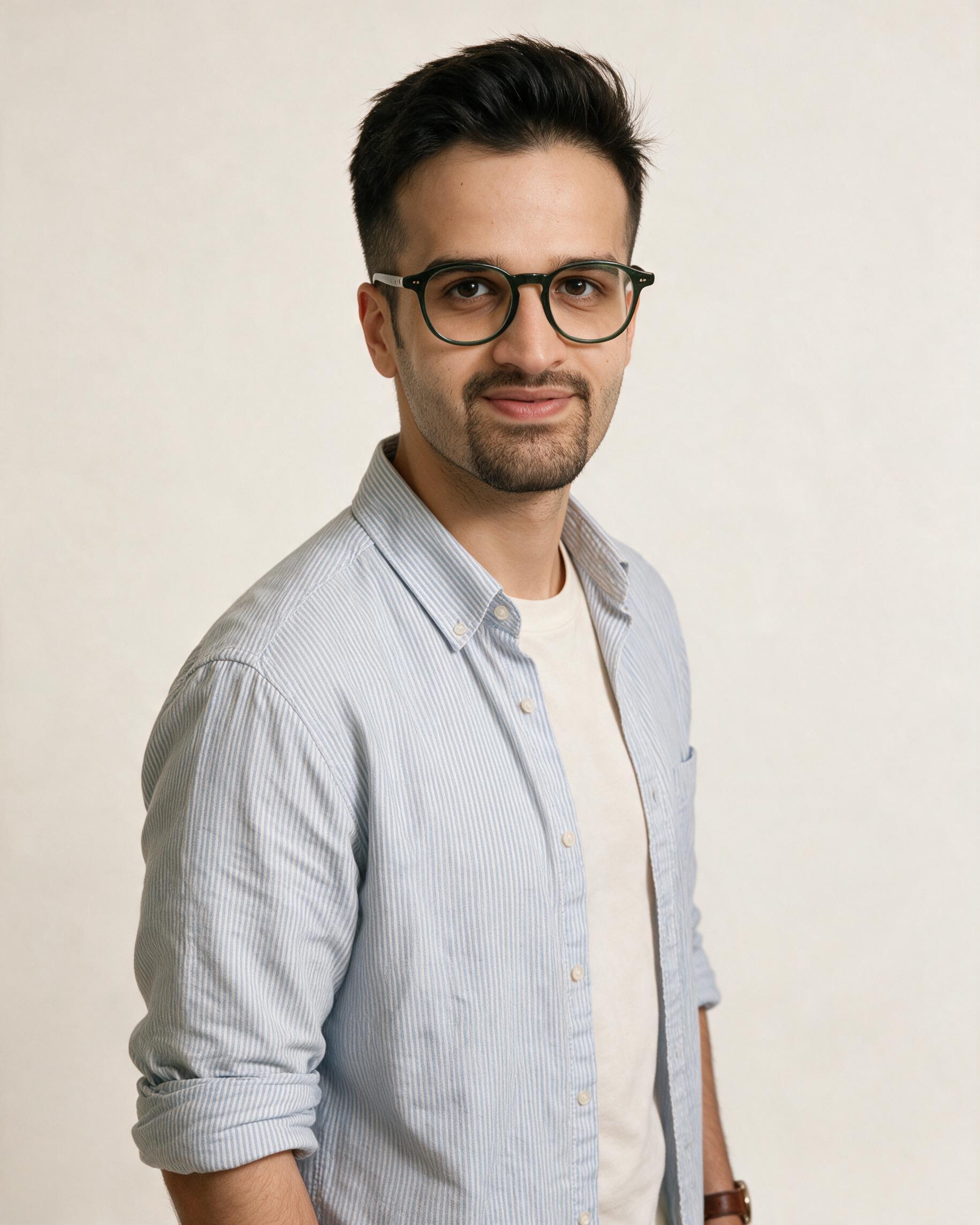 hero-portrait100%
prompt
The attached photographs are all of ONE REAL MAN. Image 1 is the primary face reference.

Produce a new photograph of that same man. Copy his likeness directly from the attached photographs: the same face, the same head and skull shape, the same hairline, the same beard, the same skin tone and ethnicity, the same build.

This is a photo edit of a real individual. Do NOT design a new character. Do NOT substitute a generic handsome face. Do NOT change his ethnicity. A viewer who knows this man must recognise him instantly.

Change only the scene, the pose, the wardrobe and the light, as specified here:

Framing: Head and shoulders, three-quarter turn to camera, eyes to lens.
The framing is the final word on what is in frame. Wardrobe items the crop cannot reach — shoes, trousers, a watch — are simply out of shot. Do NOT widen the shot to include them.
Scene: A plain seamless off-white studio backdrop with a soft floor shadow. Nothing else in frame.
Wardrobe: Open light-blue pinstripe oxford shirt over a plain cream crew-neck tee, slim black chinos, a brown leather-strap watch on the left wrist, grey trail sneakers. The oxford sleeves are rolled to just below the elbow in every panel, never worn long and never buttoned at the cuff.
Expression: Neutral and open, the faintest half-smile, relaxed jaw.
Light: Even, soft, neutral studio light from the front and both sides. Flat and honest, built for design inspection rather than drama.

Photographic style: Candid documentary photography. A full-frame camera with a 35 mm or 50 mm prime at f/2.0. Natural or soft window light. Believable skin texture with visible pores. Slight natural grain. Honest colour.
Avoid: Stock-photo staging. Studio beauty retouching. HDR. Heavy bokeh swirl. Teal-and-orange grading. Fisheye. Motion blur. Text, captions, watermarks or logos anywhere in the frame. Extra people unless the shot asks for them.

## CHECK YOUR OUTPUT AGAINST THE PHOTOGRAPHS
Before you finish, compare the face you have drawn with the attached photographs. These traits are the ones that drift. Each one must match the photographs:

- tall forehead, about 35% of face height, high hairline with a slight recession at each temple  (critical)
- thick full hair on top with real height and body, swept up and back; sides still short and faded  (critical)
- oval face, cheekbone width about 72% of face height, BROAD softly-squared chin with real width, jaw keeping a visible angle, cheeks flat not hollow, face normally fleshed and not gaunt  (critical)
- sparse cheeks with skin showing through, density at the chin and moustache, warmer brown than the hair  (critical)
- round frames, either thin black metal or thick dark acetate, clear lenses
- straight nose of MEDIUM length and normal size, in proportion to the face, not long and not enlarged
- deep-set dark brown eyes, straight dark brows
- Iranian Persian man, fair to light olive skin, warm undertone, real pores
- early thirties
- one continuous photograph, beard and hairline blend softly into the skin, no pasted-on or cut-out edges

If the man you have drawn does not look like the man in the attached photographs, draw the face again from the photographs.
02 · Turnaround — Identical scale, posture and wardrobe in every view.
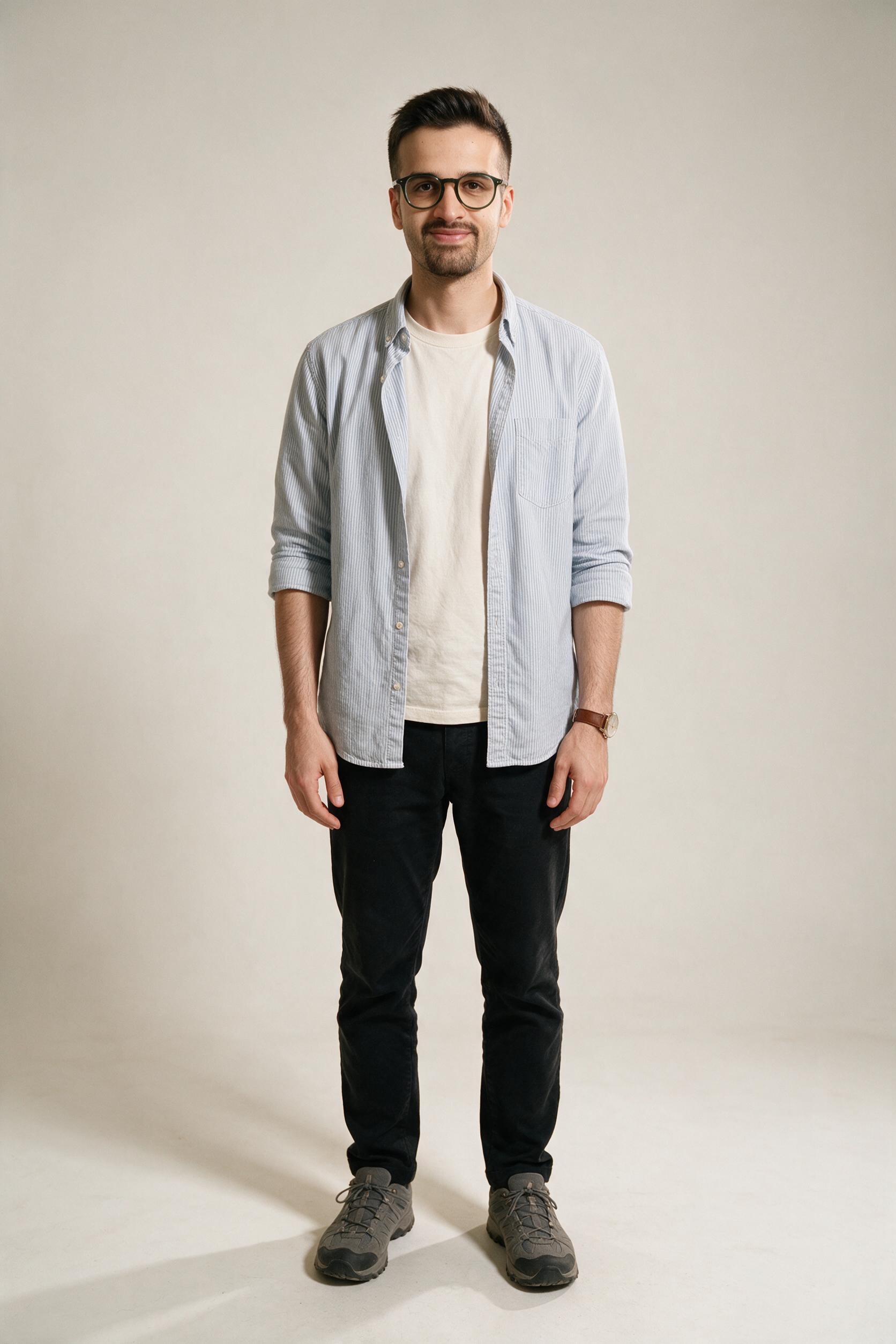 Front80%
prompt
The attached photographs are all of ONE REAL MAN. Image 1 is the primary face reference.

Produce a new photograph of that same man. Copy his likeness directly from the attached photographs: the same face, the same head and skull shape, the same hairline, the same beard, the same skin tone and ethnicity, the same build.

This is a photo edit of a real individual. Do NOT design a new character. Do NOT substitute a generic handsome face. Do NOT change his ethnicity. A viewer who knows this man must recognise him instantly.

Change only the scene, the pose, the wardrobe and the light, as specified here:

Framing: Full body head to toe, square to camera, arms relaxed at his sides, neutral standing pose.
The framing is the final word on what is in frame. Wardrobe items the crop cannot reach — shoes, trousers, a watch — are simply out of shot. Do NOT widen the shot to include them.
Scene: A plain seamless off-white studio backdrop with a soft floor shadow. Nothing else in frame.
Wardrobe: Open light-blue pinstripe oxford shirt over a plain cream crew-neck tee, slim black chinos, a brown leather-strap watch on the left wrist, grey trail sneakers. The oxford sleeves are rolled to just below the elbow in every panel, never worn long and never buttoned at the cuff.
Expression: Neutral, eyes to lens.
Light: Even, soft, neutral studio light from the front and both sides. Flat and honest, built for design inspection rather than drama.

Photographic style: Candid documentary photography. A full-frame camera with a 35 mm or 50 mm prime at f/2.0. Natural or soft window light. Believable skin texture with visible pores. Slight natural grain. Honest colour.
Avoid: Stock-photo staging. Studio beauty retouching. HDR. Heavy bokeh swirl. Teal-and-orange grading. Fisheye. Motion blur. Text, captions, watermarks or logos anywhere in the frame. Extra people unless the shot asks for them.

## CHECK YOUR OUTPUT AGAINST THE PHOTOGRAPHS
Before you finish, compare the face you have drawn with the attached photographs. These traits are the ones that drift. Each one must match the photographs:

- tall forehead, about 35% of face height, high hairline with a slight recession at each temple  (critical)
- thick full hair on top with real height and body, swept up and back; sides still short and faded  (critical)
- oval face, cheekbone width about 72% of face height, BROAD softly-squared chin with real width, jaw keeping a visible angle, cheeks flat not hollow, face normally fleshed and not gaunt  (critical)
- sparse cheeks with skin showing through, density at the chin and moustache, warmer brown than the hair  (critical)
- tall and lean, shoulders about 2.2 head-widths, slim neck, no bulk  (critical)
- round frames, either thin black metal or thick dark acetate, clear lenses
- straight nose of MEDIUM length and normal size, in proportion to the face, not long and not enlarged
- deep-set dark brown eyes, straight dark brows
- Iranian Persian man, fair to light olive skin, warm undertone, real pores
- early thirties
- one continuous photograph, beard and hairline blend softly into the skin, no pasted-on or cut-out edges
- slim fingers and wrists, only light hair on hands and forearms

If the man you have drawn does not look like the man in the attached photographs, draw the face again from the photographs.
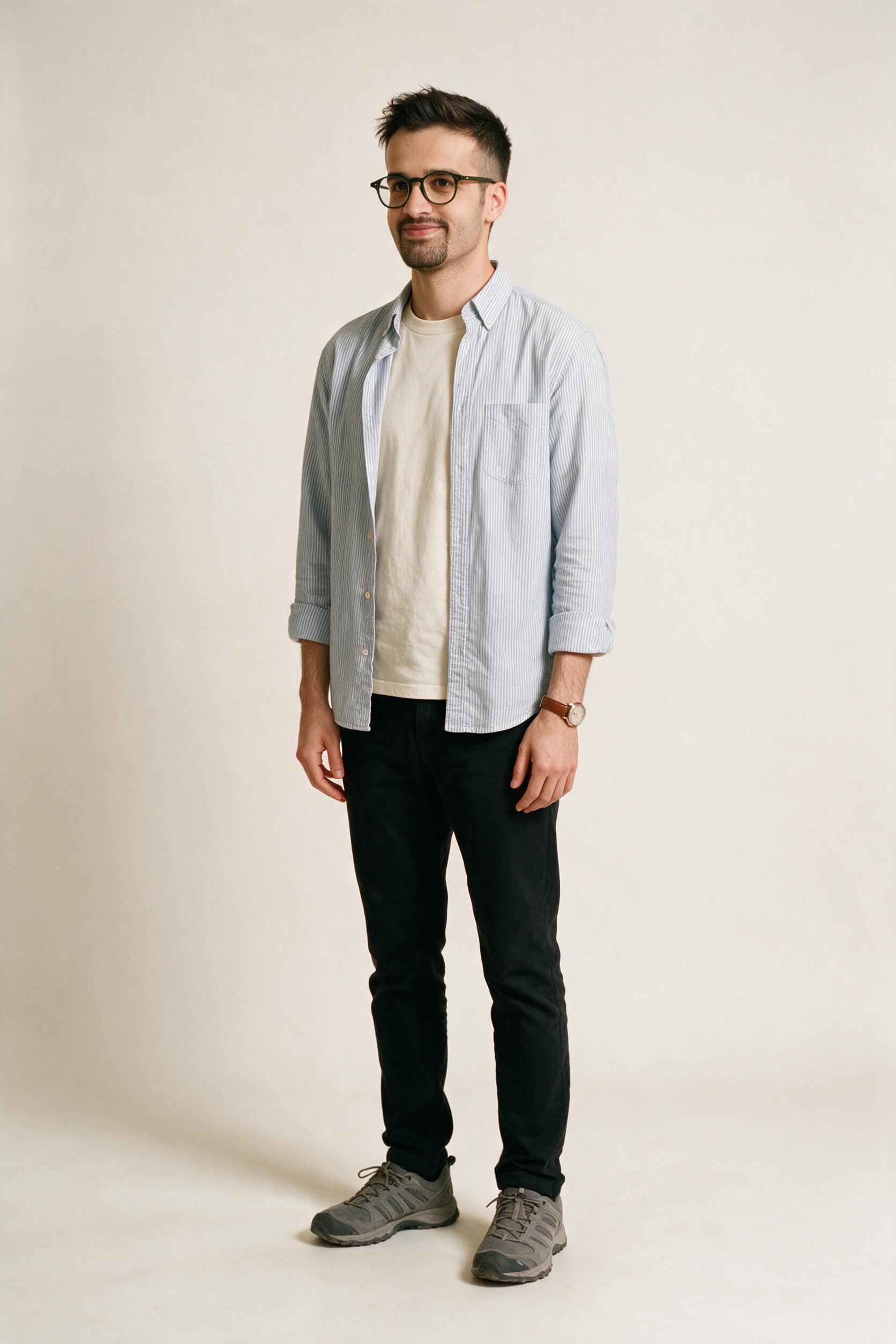 3/480%
prompt
The attached photographs are all of ONE REAL MAN. Image 1 is the primary face reference.

Produce a new photograph of that same man. Copy his likeness directly from the attached photographs: the same face, the same head and skull shape, the same hairline, the same beard, the same skin tone and ethnicity, the same build.

This is a photo edit of a real individual. Do NOT design a new character. Do NOT substitute a generic handsome face. Do NOT change his ethnicity. A viewer who knows this man must recognise him instantly.

Change only the scene, the pose, the wardrobe and the light, as specified here:

Framing: Full body head to toe, turned 45 degrees to his left, arms relaxed at his sides, same neutral stance.
The framing is the final word on what is in frame. Wardrobe items the crop cannot reach — shoes, trousers, a watch — are simply out of shot. Do NOT widen the shot to include them.
Scene: A plain seamless off-white studio backdrop with a soft floor shadow. Nothing else in frame.
Wardrobe: Open light-blue pinstripe oxford shirt over a plain cream crew-neck tee, slim black chinos, a brown leather-strap watch on the left wrist, grey trail sneakers. The oxford sleeves are rolled to just below the elbow in every panel, never worn long and never buttoned at the cuff.
Expression: Neutral, looking where the body faces.
Light: Even, soft, neutral studio light from the front and both sides. Flat and honest, built for design inspection rather than drama.

Photographic style: Candid documentary photography. A full-frame camera with a 35 mm or 50 mm prime at f/2.0. Natural or soft window light. Believable skin texture with visible pores. Slight natural grain. Honest colour.
Avoid: Stock-photo staging. Studio beauty retouching. HDR. Heavy bokeh swirl. Teal-and-orange grading. Fisheye. Motion blur. Text, captions, watermarks or logos anywhere in the frame. Extra people unless the shot asks for them.

## CHECK YOUR OUTPUT AGAINST THE PHOTOGRAPHS
Before you finish, compare the face you have drawn with the attached photographs. These traits are the ones that drift. Each one must match the photographs:

- tall forehead, about 35% of face height, high hairline with a slight recession at each temple  (critical)
- thick full hair on top with real height and body, swept up and back; sides still short and faded  (critical)
- oval face, cheekbone width about 72% of face height, BROAD softly-squared chin with real width, jaw keeping a visible angle, cheeks flat not hollow, face normally fleshed and not gaunt  (critical)
- sparse cheeks with skin showing through, density at the chin and moustache, warmer brown than the hair  (critical)
- tall and lean, shoulders about 2.2 head-widths, slim neck, no bulk  (critical)
- round frames, either thin black metal or thick dark acetate, clear lenses
- straight nose of MEDIUM length and normal size, in proportion to the face, not long and not enlarged
- deep-set dark brown eyes, straight dark brows
- Iranian Persian man, fair to light olive skin, warm undertone, real pores
- early thirties
- one continuous photograph, beard and hairline blend softly into the skin, no pasted-on or cut-out edges
- slim fingers and wrists, only light hair on hands and forearms

## FIX THESE FAULTS FROM THE PREVIOUS ATTEMPT
A previous render of this shot was rejected against the photographs. Fix every line below.

- Lighten beard to a warmer brown.

If the man you have drawn does not look like the man in the attached photographs, draw the face again from the photographs.
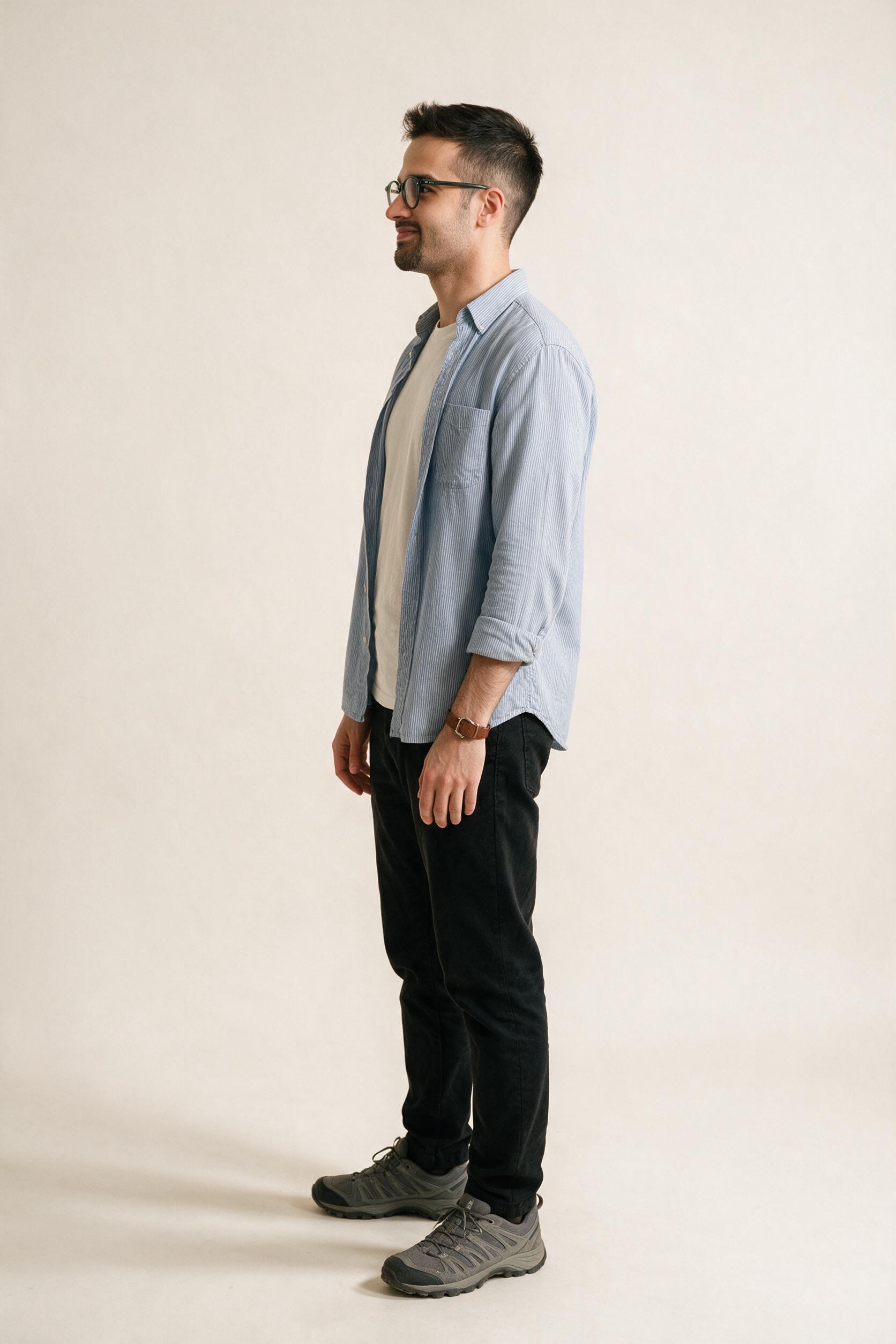 Side80%
prompt
The attached photographs are all of ONE REAL MAN. Image 1 is the primary face reference.

Produce a new photograph of that same man. Copy his likeness directly from the attached photographs: the same face, the same head and skull shape, the same hairline, the same beard, the same skin tone and ethnicity, the same build.

This is a photo edit of a real individual. Do NOT design a new character. Do NOT substitute a generic handsome face. Do NOT change his ethnicity. A viewer who knows this man must recognise him instantly.

Change only the scene, the pose, the wardrobe and the light, as specified here:

Framing: Full body head to toe in true side profile facing frame left, arms relaxed at his sides, same neutral stance.
The framing is the final word on what is in frame. Wardrobe items the crop cannot reach — shoes, trousers, a watch — are simply out of shot. Do NOT widen the shot to include them.
Scene: A plain seamless off-white studio backdrop with a soft floor shadow. Nothing else in frame.
Wardrobe: Open light-blue pinstripe oxford shirt over a plain cream crew-neck tee, slim black chinos, a brown leather-strap watch on the left wrist, grey trail sneakers. The oxford sleeves are rolled to just below the elbow in every panel, never worn long and never buttoned at the cuff.
Expression: Neutral, mouth closed.
Light: Even, soft, neutral studio light from the front and both sides. Flat and honest, built for design inspection rather than drama.

Photographic style: Candid documentary photography. A full-frame camera with a 35 mm or 50 mm prime at f/2.0. Natural or soft window light. Believable skin texture with visible pores. Slight natural grain. Honest colour.
Avoid: Stock-photo staging. Studio beauty retouching. HDR. Heavy bokeh swirl. Teal-and-orange grading. Fisheye. Motion blur. Text, captions, watermarks or logos anywhere in the frame. Extra people unless the shot asks for them.

## CHECK YOUR OUTPUT AGAINST THE PHOTOGRAPHS
Before you finish, compare the face you have drawn with the attached photographs. These traits are the ones that drift. Each one must match the photographs:

- tall forehead, about 35% of face height, high hairline with a slight recession at each temple  (critical)
- thick full hair on top with real height and body, swept up and back; sides still short and faded  (critical)
- oval face, cheekbone width about 72% of face height, BROAD softly-squared chin with real width, jaw keeping a visible angle, cheeks flat not hollow, face normally fleshed and not gaunt  (critical)
- sparse cheeks with skin showing through, density at the chin and moustache, warmer brown than the hair  (critical)
- tall and lean, shoulders about 2.2 head-widths, slim neck, no bulk  (critical)
- round frames, either thin black metal or thick dark acetate, clear lenses
- straight nose of MEDIUM length and normal size, in proportion to the face, not long and not enlarged
- deep-set dark brown eyes, straight dark brows
- Iranian Persian man, fair to light olive skin, warm undertone, real pores
- early thirties
- one continuous photograph, beard and hairline blend softly into the skin, no pasted-on or cut-out edges
- slim fingers and wrists, only light hair on hands and forearms

If the man you have drawn does not look like the man in the attached photographs, draw the face again from the photographs.
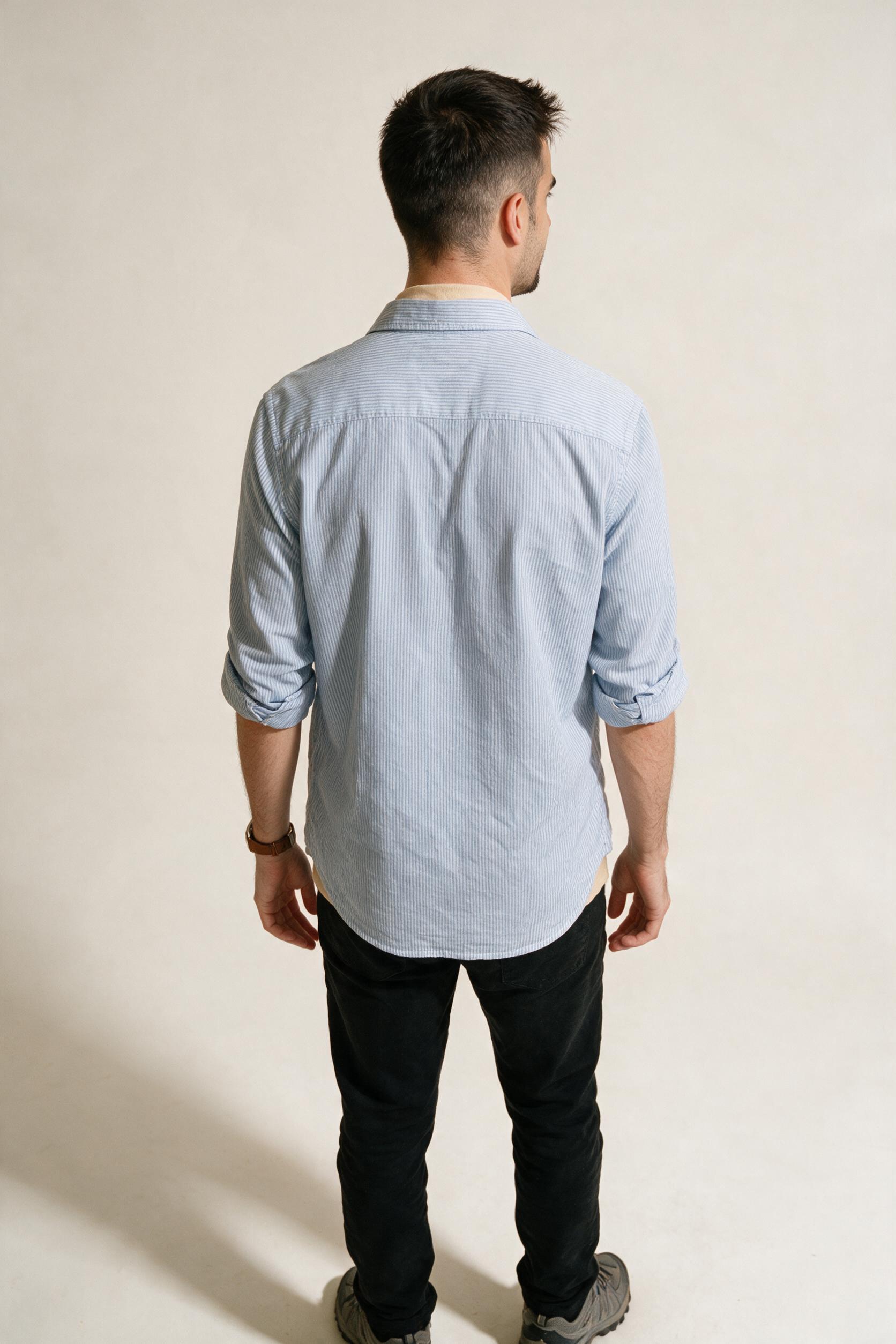 3/4 back80%
prompt
The attached photographs are all of ONE REAL MAN. Image 1 is the primary face reference.

Produce a new photograph of that same man. Copy his likeness directly from the attached photographs: the same face, the same head and skull shape, the same hairline, the same beard, the same skin tone and ethnicity, the same build.

This is a photo edit of a real individual. Do NOT design a new character. Do NOT substitute a generic handsome face. Do NOT change his ethnicity. A viewer who knows this man must recognise him instantly.

Change only the scene, the pose, the wardrobe and the light, as specified here:

Framing: Full body head to toe, standing, photographed from behind and slightly to his right. You are looking mainly at his back, and because he is angled you can also see the outer edge of his right shoulder and his right arm, and a sliver of his right cheek past the side of his head. You canNOT see his eyes, his nose, the front of his glasses or the front of his shirt. His head faces the same direction as his shoulders and is not turned back towards the camera. This is between a straight back view and a side view, closer to the back view. Same neutral stance.
The framing is the final word on what is in frame. Wardrobe items the crop cannot reach — shoes, trousers, a watch — are simply out of shot. Do NOT widen the shot to include them.
Scene: A plain seamless off-white studio backdrop with a soft floor shadow. Nothing else in frame.
Wardrobe: Open light-blue pinstripe oxford shirt over a plain cream crew-neck tee, slim black chinos, a brown leather-strap watch on the left wrist, grey trail sneakers. The oxford sleeves are rolled to just below the elbow in every panel, never worn long and never buttoned at the cuff. Seen from BEHIND, so you see the BACK of the oxford shirt: a plain yoke across the shoulders and an unbroken back panel falling from it. There is NO button placket, NO row of buttons, NO open shirt front, NO chest pocket and NO collar opening, because all of those are on the front of the shirt and the front of the shirt is facing away from the camera.
Expression: Face not visible at all, because the head faces the same way as the body.
Light: Even, soft, neutral studio light from the front and both sides. Flat and honest, built for design inspection rather than drama.

Photographic style: Candid documentary photography. A full-frame camera with a 35 mm or 50 mm prime at f/2.0. Natural or soft window light. Believable skin texture with visible pores. Slight natural grain. Honest colour.
Avoid: Stock-photo staging. Studio beauty retouching. HDR. Heavy bokeh swirl. Teal-and-orange grading. Fisheye. Motion blur. Text, captions, watermarks or logos anywhere in the frame. Extra people unless the shot asks for them.

## CHECK YOUR OUTPUT AGAINST THE PHOTOGRAPHS
Before you finish, compare the face you have drawn with the attached photographs. These traits are the ones that drift. Each one must match the photographs:

- thick full hair on top with real height and body, swept up and back; sides still short and faded  (critical)
- tall and lean, shoulders about 2.2 head-widths, slim neck, no bulk  (critical)
- Iranian Persian man, fair to light olive skin, warm undertone, real pores
- early thirties
- one continuous photograph, beard and hairline blend softly into the skin, no pasted-on or cut-out edges
- slim fingers and wrists, only light hair on hands and forearms

If the man you have drawn does not look like the man in the attached photographs, draw the face again from the photographs.
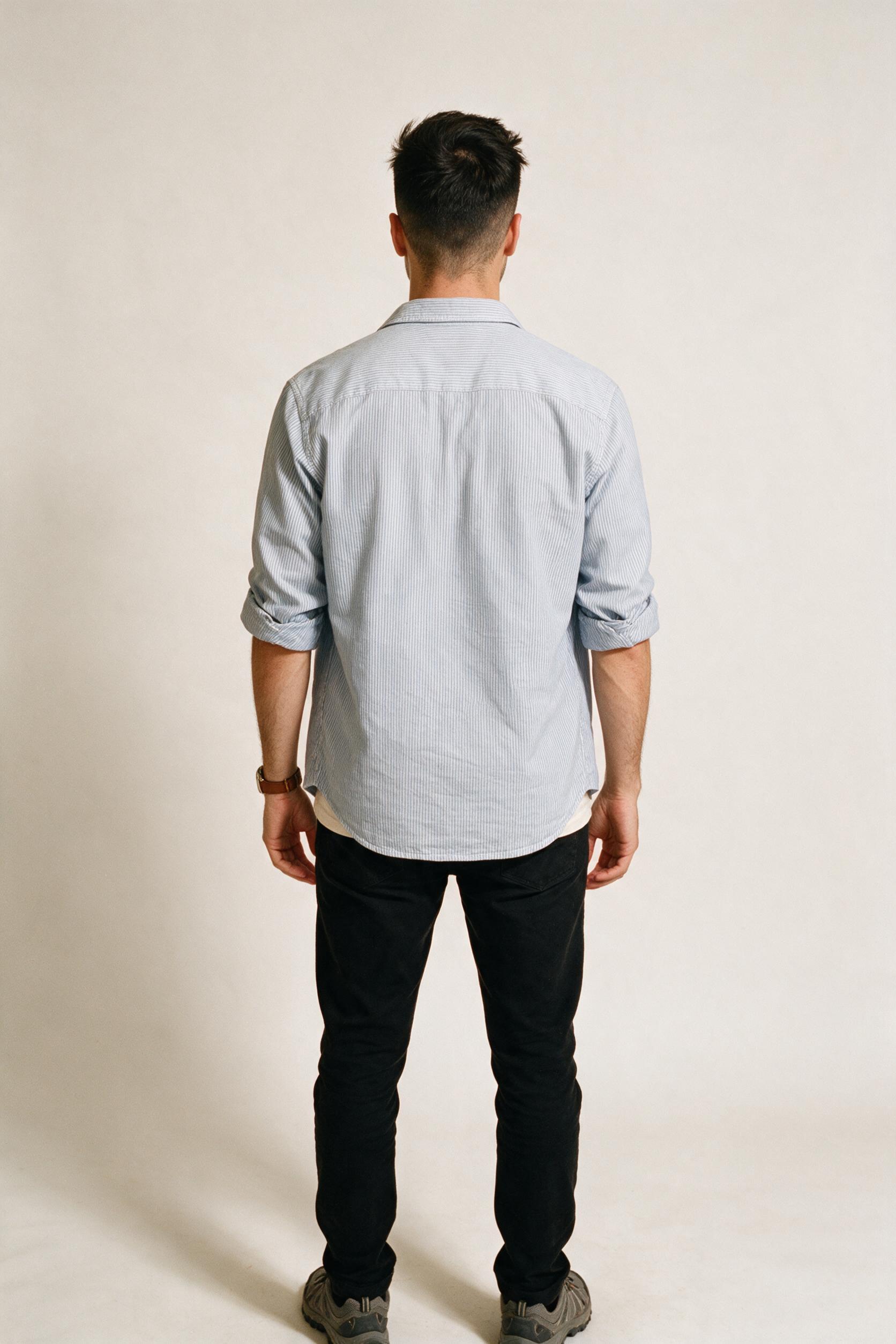 Back100%
prompt
The attached photographs are all of ONE REAL MAN. Image 1 is the primary face reference.

Produce a new photograph of that same man. Copy his likeness directly from the attached photographs: the same face, the same head and skull shape, the same hairline, the same beard, the same skin tone and ethnicity, the same build.

This is a photo edit of a real individual. Do NOT design a new character. Do NOT substitute a generic handsome face. Do NOT change his ethnicity. A viewer who knows this man must recognise him instantly.

Change only the scene, the pose, the wardrobe and the light, as specified here:

Framing: Full body head to toe, photographed from directly behind him. His whole body is turned away from the camera, shoulders and hips square to the back wall, so you are looking at his back. No part of his face is visible, and his head is NOT turned over his shoulder. Same neutral stance, showing how short the hair is cut at the back.
The framing is the final word on what is in frame. Wardrobe items the crop cannot reach — shoes, trousers, a watch — are simply out of shot. Do NOT widen the shot to include them.
Scene: A plain seamless off-white studio backdrop with a soft floor shadow. Nothing else in frame.
Wardrobe: Open light-blue pinstripe oxford shirt over a plain cream crew-neck tee, slim black chinos, a brown leather-strap watch on the left wrist, grey trail sneakers. The oxford sleeves are rolled to just below the elbow in every panel, never worn long and never buttoned at the cuff. Seen from BEHIND, so you see the BACK of the oxford shirt: a plain yoke across the shoulders and an unbroken back panel falling from it. There is NO button placket, NO row of buttons, NO open shirt front, NO chest pocket and NO collar opening, because all of those are on the front of the shirt and the front of the shirt is facing away from the camera.
Expression: Face not visible at all, because the head faces the same way as the body.
Light: Even, soft, neutral studio light from the front and both sides. Flat and honest, built for design inspection rather than drama.

Photographic style: Candid documentary photography. A full-frame camera with a 35 mm or 50 mm prime at f/2.0. Natural or soft window light. Believable skin texture with visible pores. Slight natural grain. Honest colour.
Avoid: Stock-photo staging. Studio beauty retouching. HDR. Heavy bokeh swirl. Teal-and-orange grading. Fisheye. Motion blur. Text, captions, watermarks or logos anywhere in the frame. Extra people unless the shot asks for them.

## CHECK YOUR OUTPUT AGAINST THE PHOTOGRAPHS
Before you finish, compare the face you have drawn with the attached photographs. These traits are the ones that drift. Each one must match the photographs:

- thick full hair on top with real height and body, swept up and back; sides still short and faded  (critical)
- tall and lean, shoulders about 2.2 head-widths, slim neck, no bulk  (critical)
- Iranian Persian man, fair to light olive skin, warm undertone, real pores
- early thirties
- one continuous photograph, beard and hairline blend softly into the skin, no pasted-on or cut-out edges
- slim fingers and wrists, only light hair on hands and forearms

If the man you have drawn does not look like the man in the attached photographs, draw the face again from the photographs.
03 · Expressions — Same identity, same head framing, believable facial acting.
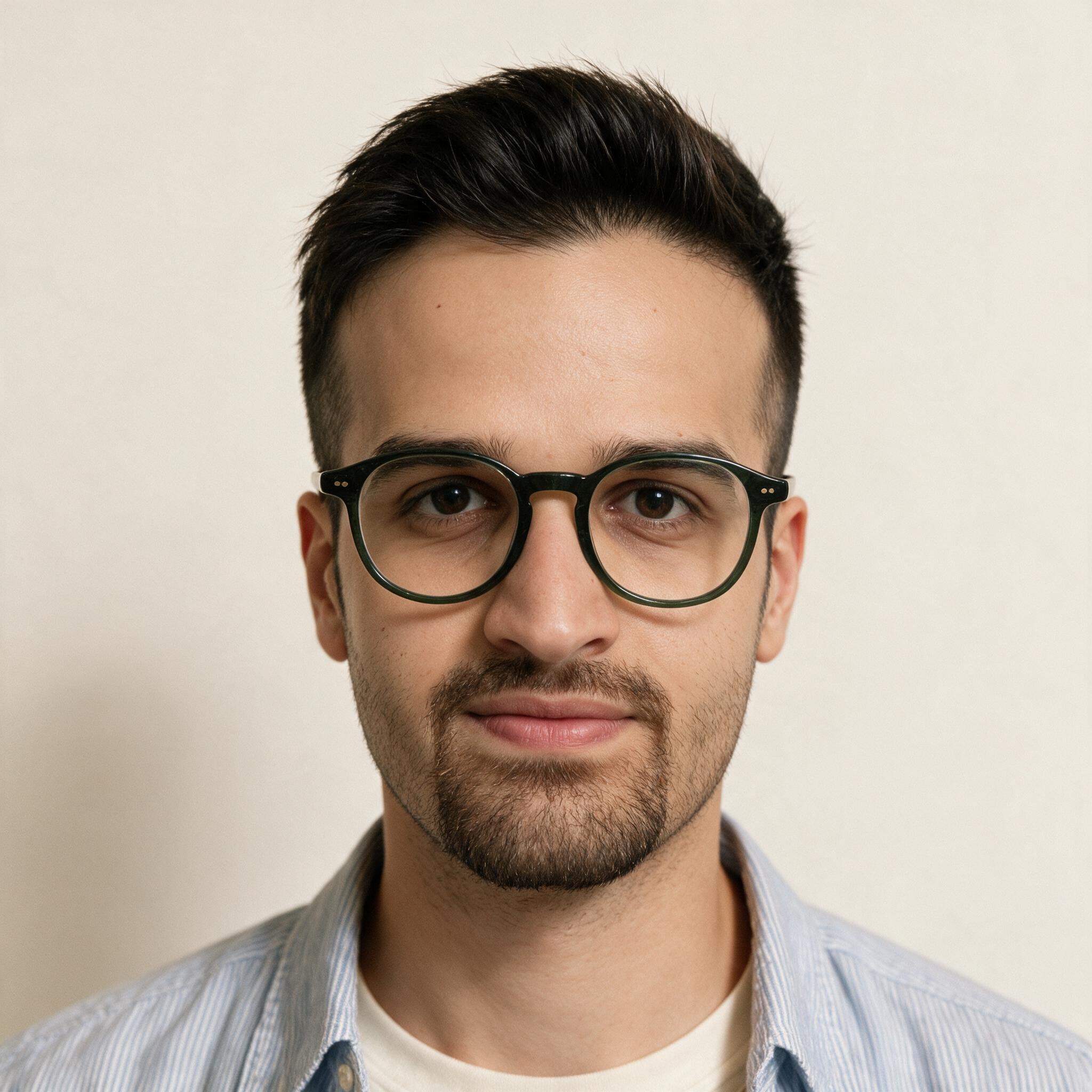 Neutral80%
prompt
The attached photographs are all of ONE REAL MAN. Image 1 is the primary face reference.

Produce a new photograph of that same man. Copy his likeness directly from the attached photographs: the same face, the same head and skull shape, the same hairline, the same beard, the same skin tone and ethnicity, the same build.

This is a photo edit of a real individual. Do NOT design a new character. Do NOT substitute a generic handsome face. Do NOT change his ethnicity. A viewer who knows this man must recognise him instantly.

Change only the scene, the pose, the wardrobe and the light, as specified here:

Framing: Head and shoulders, square to camera, eyes to lens. The frame ends at the upper chest; the waist, hands and legs are out of shot. Identical framing in every expression panel.
The framing is the final word on what is in frame. Wardrobe items the crop cannot reach — shoes, trousers, a watch — are simply out of shot. Do NOT widen the shot to include them.
Scene: A plain seamless off-white studio backdrop with a soft floor shadow. Nothing else in frame.
Wardrobe: Open light-blue pinstripe oxford shirt over a plain cream crew-neck tee, slim black chinos, a brown leather-strap watch on the left wrist, grey trail sneakers. The oxford sleeves are rolled to just below the elbow in every panel, never worn long and never buttoned at the cuff.
Expression: Completely neutral and at rest. Mouth closed and level, no lift at either corner, jaw relaxed, brows still. This is not a soft smile.
Light: Even, soft, neutral studio light from the front and both sides. Flat and honest, built for design inspection rather than drama.

Photographic style: Candid documentary photography. A full-frame camera with a 35 mm or 50 mm prime at f/2.0. Natural or soft window light. Believable skin texture with visible pores. Slight natural grain. Honest colour.
Avoid: Stock-photo staging. Studio beauty retouching. HDR. Heavy bokeh swirl. Teal-and-orange grading. Fisheye. Motion blur. Text, captions, watermarks or logos anywhere in the frame. Extra people unless the shot asks for them.

## CHECK YOUR OUTPUT AGAINST THE PHOTOGRAPHS
Before you finish, compare the face you have drawn with the attached photographs. These traits are the ones that drift. Each one must match the photographs:

- tall forehead, about 35% of face height, high hairline with a slight recession at each temple  (critical)
- thick full hair on top with real height and body, swept up and back; sides still short and faded  (critical)
- oval face, cheekbone width about 72% of face height, BROAD softly-squared chin with real width, jaw keeping a visible angle, cheeks flat not hollow, face normally fleshed and not gaunt  (critical)
- sparse cheeks with skin showing through, density at the chin and moustache, warmer brown than the hair  (critical)
- round frames, either thin black metal or thick dark acetate, clear lenses
- straight nose of MEDIUM length and normal size, in proportion to the face, not long and not enlarged
- deep-set dark brown eyes, straight dark brows
- Iranian Persian man, fair to light olive skin, warm undertone, real pores
- early thirties
- one continuous photograph, beard and hairline blend softly into the skin, no pasted-on or cut-out edges

## FIX THESE FAULTS FROM THE PREVIOUS ATTEMPT
A previous render of this shot was rejected against the photographs. Fix every line below.

- Crop is head and shoulders instead of head only. Expression and visible wardrobe match.

If the man you have drawn does not look like the man in the attached photographs, draw the face again from the photographs.
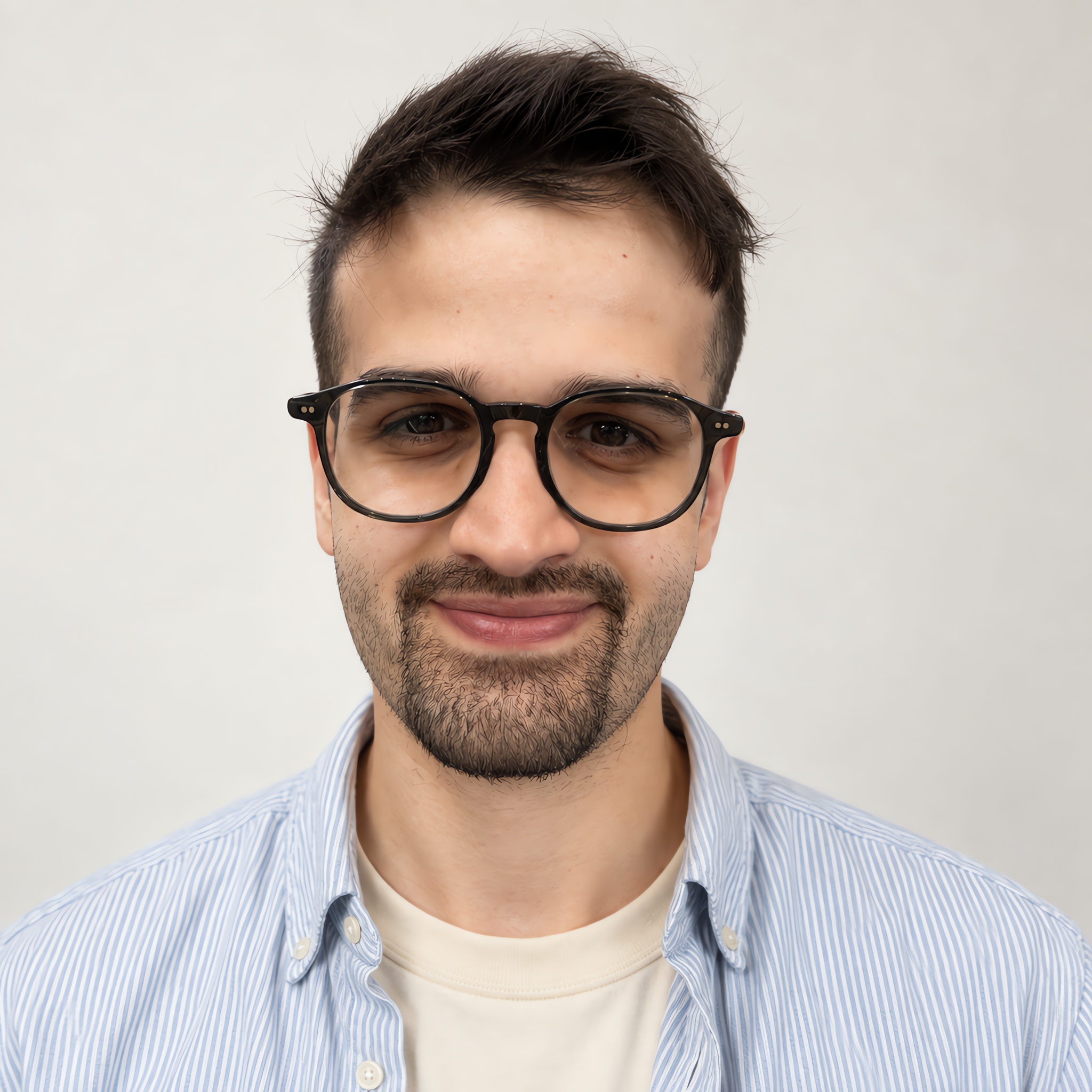 Smile80%
prompt
The attached photographs are all of ONE REAL MAN. Image 1 is the primary face reference.

Produce a new photograph of that same man. Copy his likeness directly from the attached photographs: the same face, the same head and skull shape, the same hairline, the same beard, the same skin tone and ethnicity, the same build.

This is a photo edit of a real individual. Do NOT design a new character. Do NOT substitute a generic handsome face. Do NOT change his ethnicity. A viewer who knows this man must recognise him instantly.

Change only the scene, the pose, the wardrobe and the light, as specified here:

Framing: Head and shoulders, square to camera, eyes to lens. The frame ends at the upper chest; the waist, hands and legs are out of shot. Identical framing in every expression panel.
The framing is the final word on what is in frame. Wardrobe items the crop cannot reach — shoes, trousers, a watch — are simply out of shot. Do NOT widen the shot to include them.
Scene: A plain seamless off-white studio backdrop with a soft floor shadow. Nothing else in frame.
Wardrobe: Open light-blue pinstripe oxford shirt over a plain cream crew-neck tee, slim black chinos, a brown leather-strap watch on the left wrist, grey trail sneakers. The oxford sleeves are rolled to just below the elbow in every panel, never worn long and never buttoned at the cuff.
Expression: A warm closed-mouth smile. Lips together, no teeth, cheeks lifting slightly, eyes softly engaged and a little narrowed. Clearly a smile, and clearly warmer than the neutral and serious panels.
Light: Even, soft, neutral studio light from the front and both sides. Flat and honest, built for design inspection rather than drama.

Photographic style: Candid documentary photography. A full-frame camera with a 35 mm or 50 mm prime at f/2.0. Natural or soft window light. Believable skin texture with visible pores. Slight natural grain. Honest colour.
Avoid: Stock-photo staging. Studio beauty retouching. HDR. Heavy bokeh swirl. Teal-and-orange grading. Fisheye. Motion blur. Text, captions, watermarks or logos anywhere in the frame. Extra people unless the shot asks for them.

## CHECK YOUR OUTPUT AGAINST THE PHOTOGRAPHS
Before you finish, compare the face you have drawn with the attached photographs. These traits are the ones that drift. Each one must match the photographs:

- tall forehead, about 35% of face height, high hairline with a slight recession at each temple  (critical)
- thick full hair on top with real height and body, swept up and back; sides still short and faded  (critical)
- oval face, cheekbone width about 72% of face height, BROAD softly-squared chin with real width, jaw keeping a visible angle, cheeks flat not hollow, face normally fleshed and not gaunt  (critical)
- sparse cheeks with skin showing through, density at the chin and moustache, warmer brown than the hair  (critical)
- round frames, either thin black metal or thick dark acetate, clear lenses
- straight nose of MEDIUM length and normal size, in proportion to the face, not long and not enlarged
- deep-set dark brown eyes, straight dark brows
- Iranian Persian man, fair to light olive skin, warm undertone, real pores
- early thirties
- one continuous photograph, beard and hairline blend softly into the skin, no pasted-on or cut-out edges

## FIX THESE FAULTS FROM THE PREVIOUS ATTEMPT
A previous render of this shot was rejected against the photographs. Fix every line below.

- Deepen the temple recession to match the reference.

If the man you have drawn does not look like the man in the attached photographs, draw the face again from the photographs.
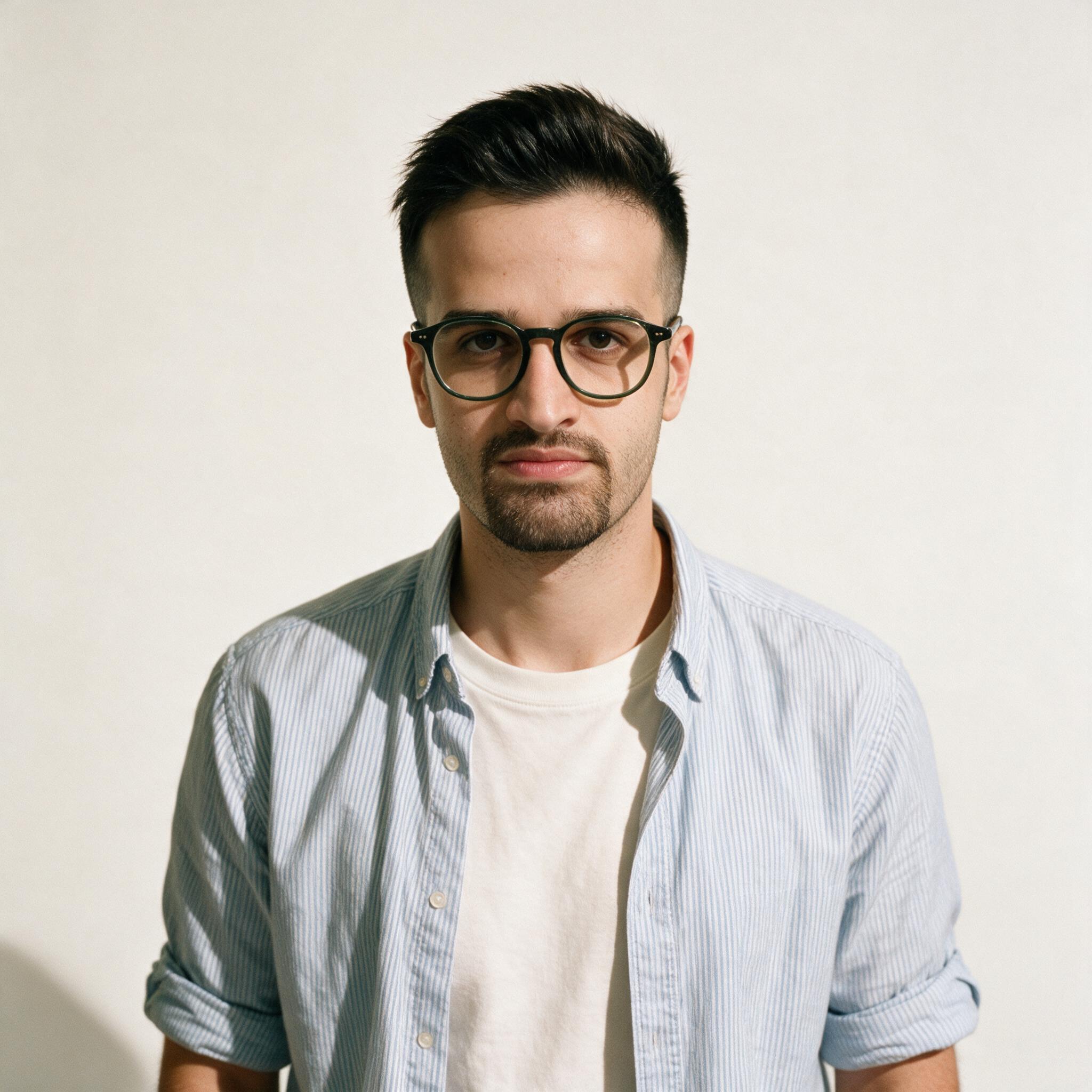 Serious80%
prompt
The attached photographs are all of ONE REAL MAN. Image 1 is the primary face reference.

Produce a new photograph of that same man. Copy his likeness directly from the attached photographs: the same face, the same head and skull shape, the same hairline, the same beard, the same skin tone and ethnicity, the same build.

This is a photo edit of a real individual. Do NOT design a new character. Do NOT substitute a generic handsome face. Do NOT change his ethnicity. A viewer who knows this man must recognise him instantly.

Change only the scene, the pose, the wardrobe and the light, as specified here:

Framing: Head and shoulders, square to camera, eyes to lens. The frame ends at the upper chest; the waist, hands and legs are out of shot. Identical framing in every expression panel.
The framing is the final word on what is in frame. Wardrobe items the crop cannot reach — shoes, trousers, a watch — are simply out of shot. Do NOT widen the shot to include them.
Scene: A plain seamless off-white studio backdrop with a soft floor shadow. Nothing else in frame.
Wardrobe: Open light-blue pinstripe oxford shirt over a plain cream crew-neck tee, slim black chinos, a brown leather-strap watch on the left wrist, grey trail sneakers. The oxford sleeves are rolled to just below the elbow in every panel, never worn long and never buttoned at the cuff.
Expression: Serious and level. Mouth closed and still with BOTH corners level or very slightly down, brows neutral, gaze direct and unsmiling. There is NO lift at either corner of the mouth. It must not read as a faint or closed-mouth smile.
Light: Even, soft, neutral studio light from the front and both sides. Flat and honest, built for design inspection rather than drama.

Photographic style: Candid documentary photography. A full-frame camera with a 35 mm or 50 mm prime at f/2.0. Natural or soft window light. Believable skin texture with visible pores. Slight natural grain. Honest colour.
Avoid: Stock-photo staging. Studio beauty retouching. HDR. Heavy bokeh swirl. Teal-and-orange grading. Fisheye. Motion blur. Text, captions, watermarks or logos anywhere in the frame. Extra people unless the shot asks for them.

## CHECK YOUR OUTPUT AGAINST THE PHOTOGRAPHS
Before you finish, compare the face you have drawn with the attached photographs. These traits are the ones that drift. Each one must match the photographs:

- tall forehead, about 35% of face height, high hairline with a slight recession at each temple  (critical)
- thick full hair on top with real height and body, swept up and back; sides still short and faded  (critical)
- oval face, cheekbone width about 72% of face height, BROAD softly-squared chin with real width, jaw keeping a visible angle, cheeks flat not hollow, face normally fleshed and not gaunt  (critical)
- sparse cheeks with skin showing through, density at the chin and moustache, warmer brown than the hair  (critical)
- round frames, either thin black metal or thick dark acetate, clear lenses
- straight nose of MEDIUM length and normal size, in proportion to the face, not long and not enlarged
- deep-set dark brown eyes, straight dark brows
- Iranian Persian man, fair to light olive skin, warm undertone, real pores
- early thirties
- one continuous photograph, beard and hairline blend softly into the skin, no pasted-on or cut-out edges

If the man you have drawn does not look like the man in the attached photographs, draw the face again from the photographs.
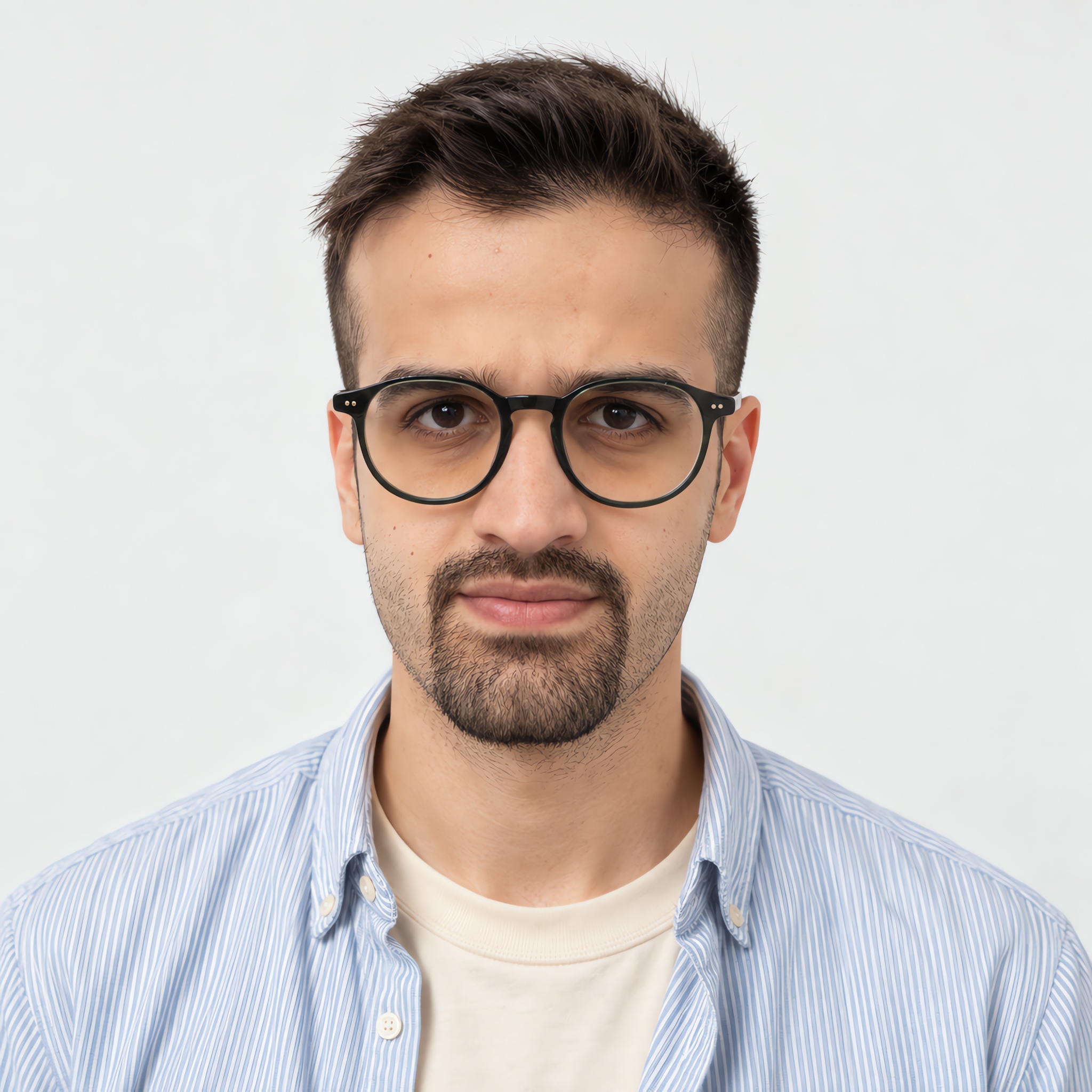 Focused80%
prompt
The attached photographs are all of ONE REAL MAN. Image 1 is the primary face reference.

Produce a new photograph of that same man. Copy his likeness directly from the attached photographs: the same face, the same head and skull shape, the same hairline, the same beard, the same skin tone and ethnicity, the same build.

This is a photo edit of a real individual. Do NOT design a new character. Do NOT substitute a generic handsome face. Do NOT change his ethnicity. A viewer who knows this man must recognise him instantly.

Change only the scene, the pose, the wardrobe and the light, as specified here:

Framing: Head and shoulders, square to camera, eyes to lens. The frame ends at the upper chest; the waist, hands and legs are out of shot. Identical framing in every expression panel.
The framing is the final word on what is in frame. Wardrobe items the crop cannot reach — shoes, trousers, a watch — are simply out of shot. Do NOT widen the shot to include them.
Scene: A plain seamless off-white studio backdrop with a soft floor shadow. Nothing else in frame.
Wardrobe: Open light-blue pinstripe oxford shirt over a plain cream crew-neck tee, slim black chinos, a brown leather-strap watch on the left wrist, grey trail sneakers. The oxford sleeves are rolled to just below the elbow in every panel, never worn long and never buttoned at the cuff.
Expression: Concentrating, brows drawn slightly together, mouth closed.
Light: Even, soft, neutral studio light from the front and both sides. Flat and honest, built for design inspection rather than drama.

Photographic style: Candid documentary photography. A full-frame camera with a 35 mm or 50 mm prime at f/2.0. Natural or soft window light. Believable skin texture with visible pores. Slight natural grain. Honest colour.
Avoid: Stock-photo staging. Studio beauty retouching. HDR. Heavy bokeh swirl. Teal-and-orange grading. Fisheye. Motion blur. Text, captions, watermarks or logos anywhere in the frame. Extra people unless the shot asks for them.

## CHECK YOUR OUTPUT AGAINST THE PHOTOGRAPHS
Before you finish, compare the face you have drawn with the attached photographs. These traits are the ones that drift. Each one must match the photographs:

- tall forehead, about 35% of face height, high hairline with a slight recession at each temple  (critical)
- thick full hair on top with real height and body, swept up and back; sides still short and faded  (critical)
- oval face, cheekbone width about 72% of face height, BROAD softly-squared chin with real width, jaw keeping a visible angle, cheeks flat not hollow, face normally fleshed and not gaunt  (critical)
- sparse cheeks with skin showing through, density at the chin and moustache, warmer brown than the hair  (critical)
- round frames, either thin black metal or thick dark acetate, clear lenses
- straight nose of MEDIUM length and normal size, in proportion to the face, not long and not enlarged
- deep-set dark brown eyes, straight dark brows
- Iranian Persian man, fair to light olive skin, warm undertone, real pores
- early thirties
- one continuous photograph, beard and hairline blend softly into the skin, no pasted-on or cut-out edges

## FIX THESE FAULTS FROM THE PREVIOUS ATTEMPT
A previous render of this shot was rejected against the photographs. Fix every line below.

- Expression is neutral with relaxed brows; brief requested concentrating with brows drawn slightly together.

If the man you have drawn does not look like the man in the attached photographs, draw the face again from the photographs.
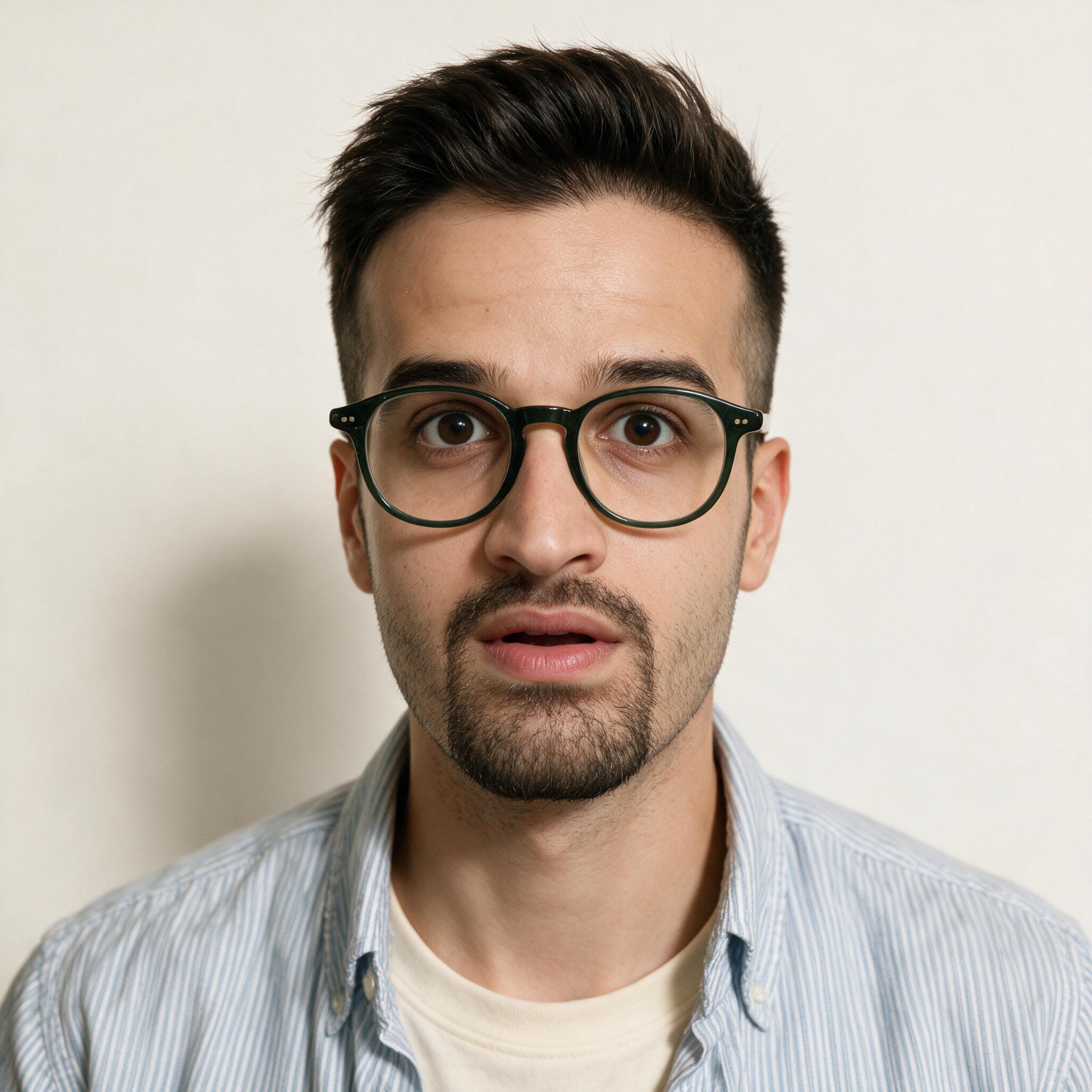 Surprised80%
prompt
The attached photographs are all of ONE REAL MAN. Image 1 is the primary face reference.

Produce a new photograph of that same man. Copy his likeness directly from the attached photographs: the same face, the same head and skull shape, the same hairline, the same beard, the same skin tone and ethnicity, the same build.

This is a photo edit of a real individual. Do NOT design a new character. Do NOT substitute a generic handsome face. Do NOT change his ethnicity. A viewer who knows this man must recognise him instantly.

Change only the scene, the pose, the wardrobe and the light, as specified here:

Framing: Head and shoulders, square to camera, eyes to lens. The frame ends at the upper chest; the waist, hands and legs are out of shot. Identical framing in every expression panel.
The framing is the final word on what is in frame. Wardrobe items the crop cannot reach — shoes, trousers, a watch — are simply out of shot. Do NOT widen the shot to include them.
Scene: A plain seamless off-white studio backdrop with a soft floor shadow. Nothing else in frame.
Wardrobe: Open light-blue pinstripe oxford shirt over a plain cream crew-neck tee, slim black chinos, a brown leather-strap watch on the left wrist, grey trail sneakers. The oxford sleeves are rolled to just below the elbow in every panel, never worn long and never buttoned at the cuff.
Expression: Genuinely surprised, brows raised, eyes widened, lips parted a little. Restrained, not theatrical.
Light: Even, soft, neutral studio light from the front and both sides. Flat and honest, built for design inspection rather than drama.

Photographic style: Candid documentary photography. A full-frame camera with a 35 mm or 50 mm prime at f/2.0. Natural or soft window light. Believable skin texture with visible pores. Slight natural grain. Honest colour.
Avoid: Stock-photo staging. Studio beauty retouching. HDR. Heavy bokeh swirl. Teal-and-orange grading. Fisheye. Motion blur. Text, captions, watermarks or logos anywhere in the frame. Extra people unless the shot asks for them.

## CHECK YOUR OUTPUT AGAINST THE PHOTOGRAPHS
Before you finish, compare the face you have drawn with the attached photographs. These traits are the ones that drift. Each one must match the photographs:

- tall forehead, about 35% of face height, high hairline with a slight recession at each temple  (critical)
- thick full hair on top with real height and body, swept up and back; sides still short and faded  (critical)
- oval face, cheekbone width about 72% of face height, BROAD softly-squared chin with real width, jaw keeping a visible angle, cheeks flat not hollow, face normally fleshed and not gaunt  (critical)
- sparse cheeks with skin showing through, density at the chin and moustache, warmer brown than the hair  (critical)
- round frames, either thin black metal or thick dark acetate, clear lenses
- straight nose of MEDIUM length and normal size, in proportion to the face, not long and not enlarged
- deep-set dark brown eyes, straight dark brows
- Iranian Persian man, fair to light olive skin, warm undertone, real pores
- early thirties
- one continuous photograph, beard and hairline blend softly into the skin, no pasted-on or cut-out edges

## FIX THESE FAULTS FROM THE PREVIOUS ATTEMPT
A previous render of this shot was rejected against the photographs. Fix every line below.

- Expression is correct. Wardrobe is missing; the neck ends in a white surface with no clothing visible.

If the man you have drawn does not look like the man in the attached photographs, draw the face again from the photographs.
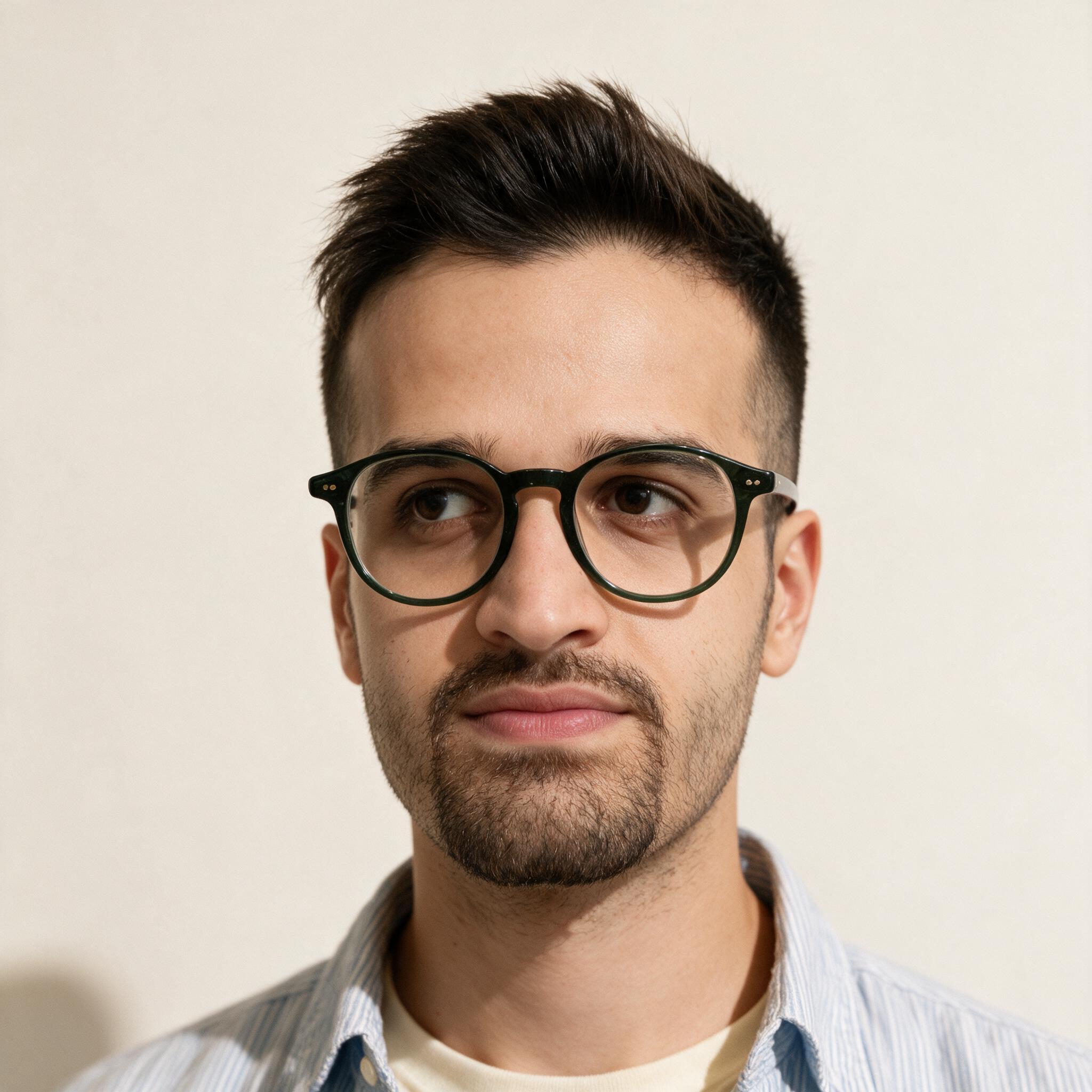 Thinking80%
prompt
The attached photographs are all of ONE REAL MAN. Image 1 is the primary face reference.

Produce a new photograph of that same man. Copy his likeness directly from the attached photographs: the same face, the same head and skull shape, the same hairline, the same beard, the same skin tone and ethnicity, the same build.

This is a photo edit of a real individual. Do NOT design a new character. Do NOT substitute a generic handsome face. Do NOT change his ethnicity. A viewer who knows this man must recognise him instantly.

Change only the scene, the pose, the wardrobe and the light, as specified here:

Framing: Head and shoulders, square to camera, eyes to lens. The frame ends at the upper chest; the waist, hands and legs are out of shot. Identical framing in every expression panel.
The framing is the final word on what is in frame. Wardrobe items the crop cannot reach — shoes, trousers, a watch — are simply out of shot. Do NOT widen the shot to include them.
Scene: A plain seamless off-white studio backdrop with a soft floor shadow. Nothing else in frame.
Wardrobe: Open light-blue pinstripe oxford shirt over a plain cream crew-neck tee, slim black chinos, a brown leather-strap watch on the left wrist, grey trail sneakers. The oxford sleeves are rolled to just below the elbow in every panel, never worn long and never buttoned at the cuff.
Expression: Thinking something through, mouth closed, gaze off camera.
Light: Even, soft, neutral studio light from the front and both sides. Flat and honest, built for design inspection rather than drama.

Photographic style: Candid documentary photography. A full-frame camera with a 35 mm or 50 mm prime at f/2.0. Natural or soft window light. Believable skin texture with visible pores. Slight natural grain. Honest colour.
Avoid: Stock-photo staging. Studio beauty retouching. HDR. Heavy bokeh swirl. Teal-and-orange grading. Fisheye. Motion blur. Text, captions, watermarks or logos anywhere in the frame. Extra people unless the shot asks for them.

## CHECK YOUR OUTPUT AGAINST THE PHOTOGRAPHS
Before you finish, compare the face you have drawn with the attached photographs. These traits are the ones that drift. Each one must match the photographs:

- tall forehead, about 35% of face height, high hairline with a slight recession at each temple  (critical)
- thick full hair on top with real height and body, swept up and back; sides still short and faded  (critical)
- oval face, cheekbone width about 72% of face height, BROAD softly-squared chin with real width, jaw keeping a visible angle, cheeks flat not hollow, face normally fleshed and not gaunt  (critical)
- sparse cheeks with skin showing through, density at the chin and moustache, warmer brown than the hair  (critical)
- round frames, either thin black metal or thick dark acetate, clear lenses
- straight nose of MEDIUM length and normal size, in proportion to the face, not long and not enlarged
- deep-set dark brown eyes, straight dark brows
- Iranian Persian man, fair to light olive skin, warm undertone, real pores
- early thirties
- one continuous photograph, beard and hairline blend softly into the skin, no pasted-on or cut-out edges

## FIX THESE FAULTS FROM THE PREVIOUS ATTEMPT
A previous render of this shot was rejected against the photographs. Fix every line below.

- Requested head only crop; delivered waist-up shot.

If the man you have drawn does not look like the man in the attached photographs, draw the face again from the photographs.
04 · Poses — Same proportions and wardrobe in every pose.
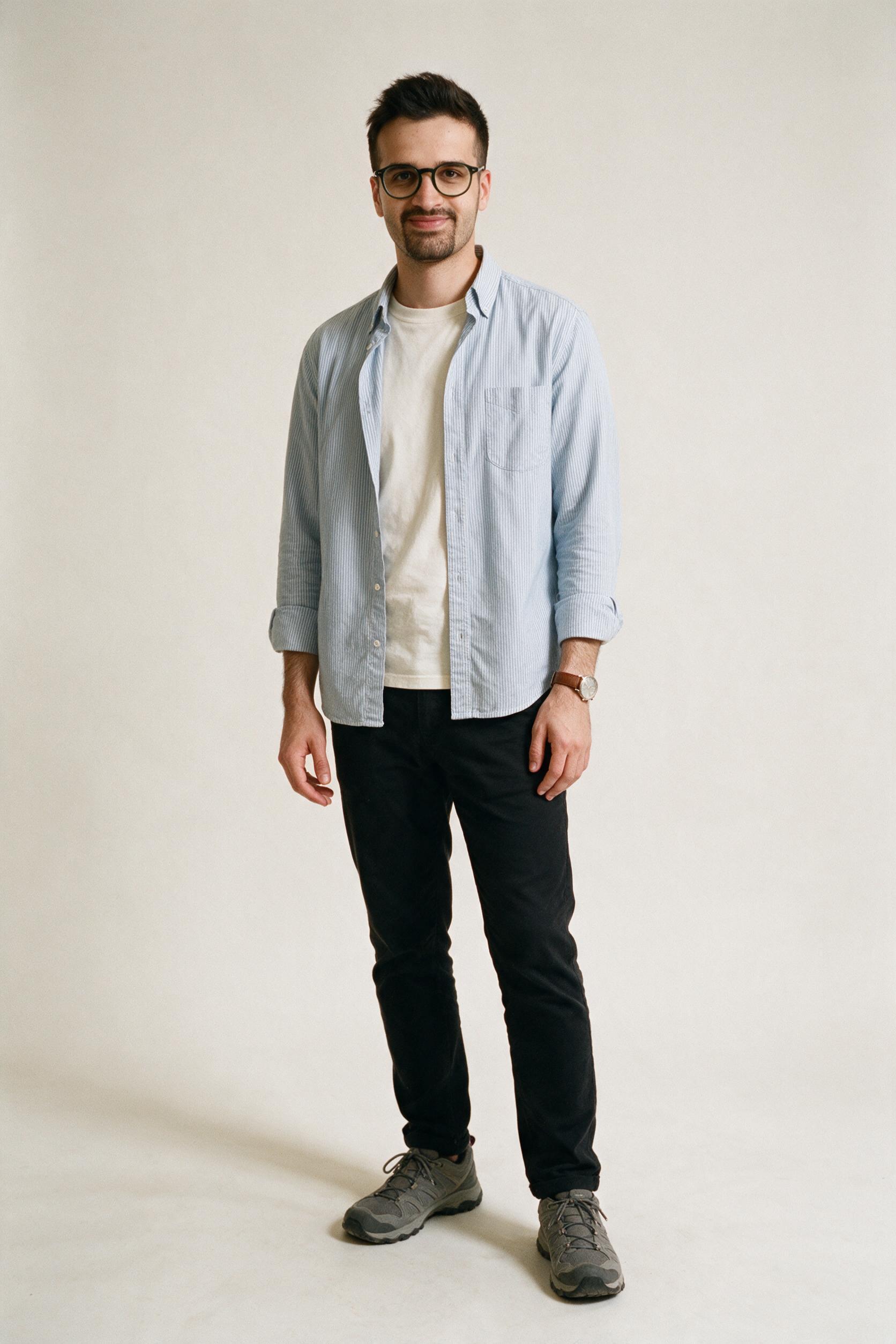 Standing80%
prompt
The attached photographs are all of ONE REAL MAN. Image 1 is the primary face reference.

Produce a new photograph of that same man. Copy his likeness directly from the attached photographs: the same face, the same head and skull shape, the same hairline, the same beard, the same skin tone and ethnicity, the same build.

This is a photo edit of a real individual. Do NOT design a new character. Do NOT substitute a generic handsome face. Do NOT change his ethnicity. A viewer who knows this man must recognise him instantly.

Change only the scene, the pose, the wardrobe and the light, as specified here:

Framing: Full body, standing relaxed, weight on one leg, hands loose at his sides.
The framing is the final word on what is in frame. Wardrobe items the crop cannot reach — shoes, trousers, a watch — are simply out of shot. Do NOT widen the shot to include them.
Scene: A plain seamless off-white studio backdrop with a soft floor shadow. Nothing else in frame.
Wardrobe: Open light-blue pinstripe oxford shirt over a plain cream crew-neck tee, slim black chinos, a brown leather-strap watch on the left wrist, grey trail sneakers. The oxford sleeves are rolled to just below the elbow in every panel, never worn long and never buttoned at the cuff.
Expression: Easy and neutral.
Light: Even, soft, neutral studio light from the front and both sides. Flat and honest, built for design inspection rather than drama.

Photographic style: Candid documentary photography. A full-frame camera with a 35 mm or 50 mm prime at f/2.0. Natural or soft window light. Believable skin texture with visible pores. Slight natural grain. Honest colour.
Avoid: Stock-photo staging. Studio beauty retouching. HDR. Heavy bokeh swirl. Teal-and-orange grading. Fisheye. Motion blur. Text, captions, watermarks or logos anywhere in the frame. Extra people unless the shot asks for them.

## CHECK YOUR OUTPUT AGAINST THE PHOTOGRAPHS
Before you finish, compare the face you have drawn with the attached photographs. These traits are the ones that drift. Each one must match the photographs:

- tall forehead, about 35% of face height, high hairline with a slight recession at each temple  (critical)
- thick full hair on top with real height and body, swept up and back; sides still short and faded  (critical)
- oval face, cheekbone width about 72% of face height, BROAD softly-squared chin with real width, jaw keeping a visible angle, cheeks flat not hollow, face normally fleshed and not gaunt  (critical)
- sparse cheeks with skin showing through, density at the chin and moustache, warmer brown than the hair  (critical)
- tall and lean, shoulders about 2.2 head-widths, slim neck, no bulk  (critical)
- round frames, either thin black metal or thick dark acetate, clear lenses
- straight nose of MEDIUM length and normal size, in proportion to the face, not long and not enlarged
- deep-set dark brown eyes, straight dark brows
- Iranian Persian man, fair to light olive skin, warm undertone, real pores
- early thirties
- one continuous photograph, beard and hairline blend softly into the skin, no pasted-on or cut-out edges
- slim fingers and wrists, only light hair on hands and forearms

## FIX THESE FAULTS FROM THE PREVIOUS ATTEMPT
A previous render of this shot was rejected against the photographs. Fix every line below.

- Increase hair volume and height on top.

If the man you have drawn does not look like the man in the attached photographs, draw the face again from the photographs.
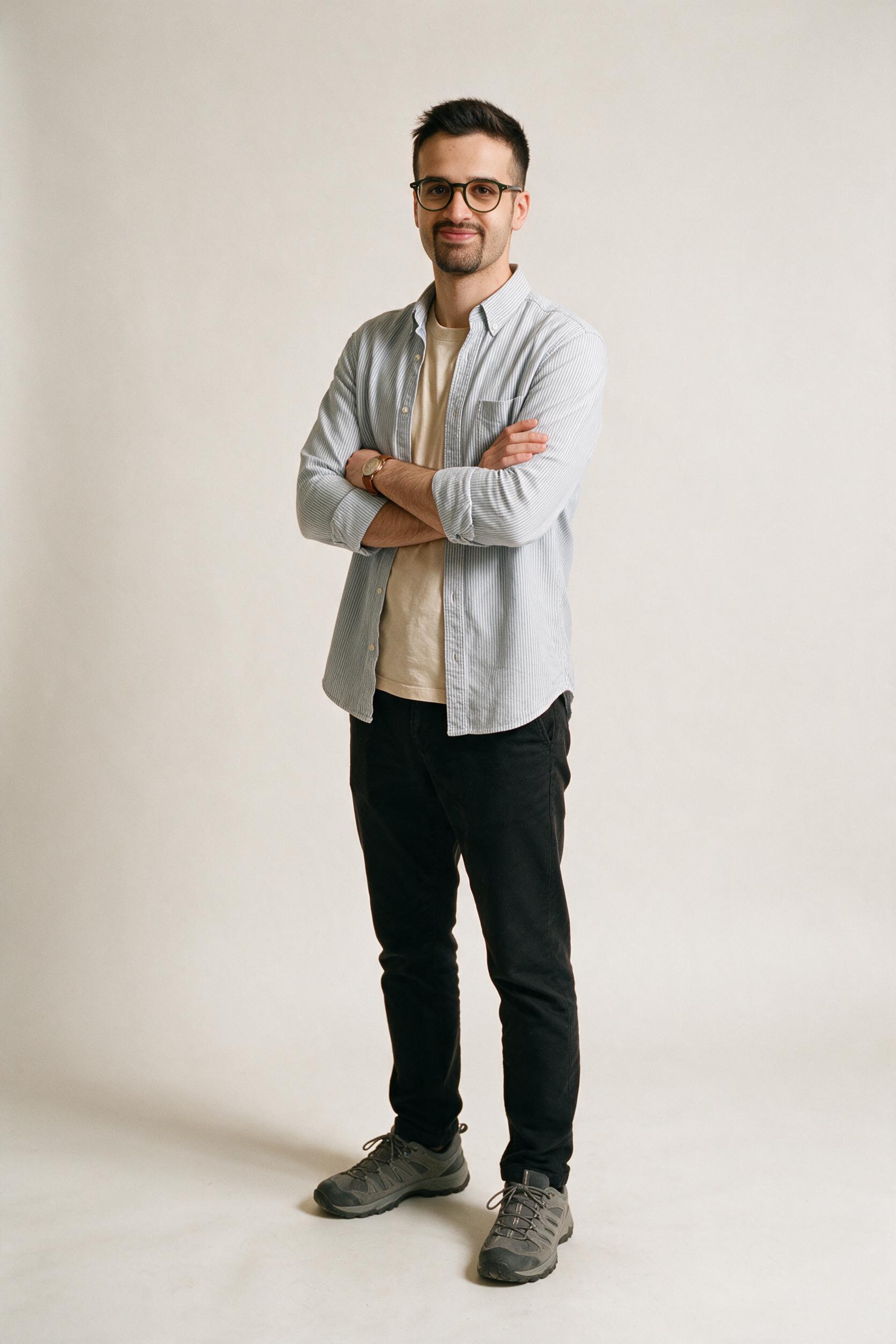 Arms folded80%
prompt
The attached photographs are all of ONE REAL MAN. Image 1 is the primary face reference.

Produce a new photograph of that same man. Copy his likeness directly from the attached photographs: the same face, the same head and skull shape, the same hairline, the same beard, the same skin tone and ethnicity, the same build.

This is a photo edit of a real individual. Do NOT design a new character. Do NOT substitute a generic handsome face. Do NOT change his ethnicity. A viewer who knows this man must recognise him instantly.

Change only the scene, the pose, the wardrobe and the light, as specified here:

Framing: Full body, standing with arms folded across the chest, turned slightly to his left.
The framing is the final word on what is in frame. Wardrobe items the crop cannot reach — shoes, trousers, a watch — are simply out of shot. Do NOT widen the shot to include them.
Scene: A plain seamless off-white studio backdrop with a soft floor shadow. Nothing else in frame.
Wardrobe: Open light-blue pinstripe oxford shirt over a plain cream crew-neck tee, slim black chinos, a brown leather-strap watch on the left wrist, grey trail sneakers. The oxford sleeves are rolled to just below the elbow in every panel, never worn long and never buttoned at the cuff.
Expression: Calm, closed-mouth half-smile.
Light: Even, soft, neutral studio light from the front and both sides. Flat and honest, built for design inspection rather than drama.

Photographic style: Candid documentary photography. A full-frame camera with a 35 mm or 50 mm prime at f/2.0. Natural or soft window light. Believable skin texture with visible pores. Slight natural grain. Honest colour.
Avoid: Stock-photo staging. Studio beauty retouching. HDR. Heavy bokeh swirl. Teal-and-orange grading. Fisheye. Motion blur. Text, captions, watermarks or logos anywhere in the frame. Extra people unless the shot asks for them.

## CHECK YOUR OUTPUT AGAINST THE PHOTOGRAPHS
Before you finish, compare the face you have drawn with the attached photographs. These traits are the ones that drift. Each one must match the photographs:

- tall forehead, about 35% of face height, high hairline with a slight recession at each temple  (critical)
- thick full hair on top with real height and body, swept up and back; sides still short and faded  (critical)
- oval face, cheekbone width about 72% of face height, BROAD softly-squared chin with real width, jaw keeping a visible angle, cheeks flat not hollow, face normally fleshed and not gaunt  (critical)
- sparse cheeks with skin showing through, density at the chin and moustache, warmer brown than the hair  (critical)
- tall and lean, shoulders about 2.2 head-widths, slim neck, no bulk  (critical)
- round frames, either thin black metal or thick dark acetate, clear lenses
- straight nose of MEDIUM length and normal size, in proportion to the face, not long and not enlarged
- deep-set dark brown eyes, straight dark brows
- Iranian Persian man, fair to light olive skin, warm undertone, real pores
- early thirties
- one continuous photograph, beard and hairline blend softly into the skin, no pasted-on or cut-out edges
- slim fingers and wrists, only light hair on hands and forearms

If the man you have drawn does not look like the man in the attached photographs, draw the face again from the photographs.
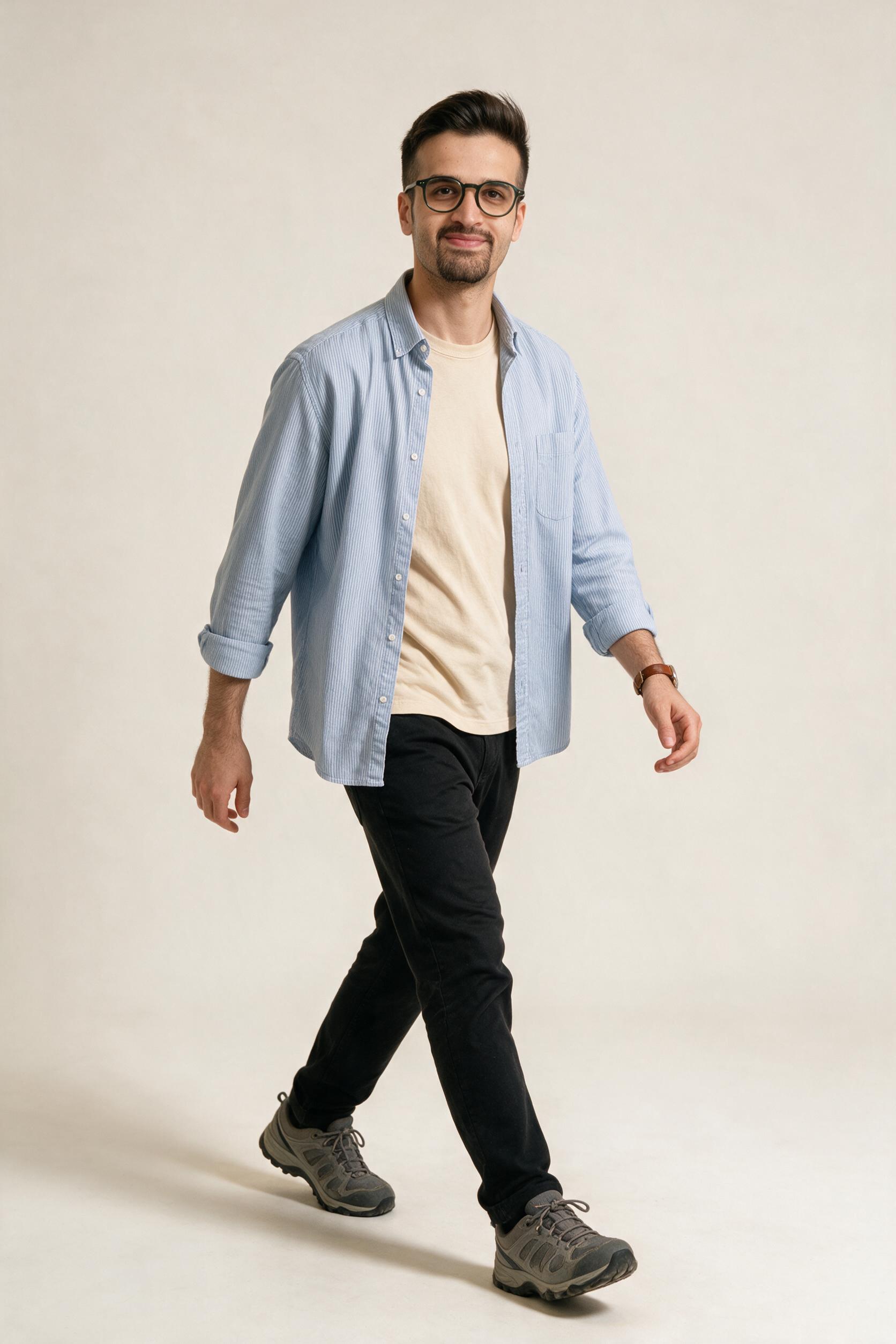 Walking80%
prompt
The attached photographs are all of ONE REAL MAN. Image 1 is the primary face reference.

Produce a new photograph of that same man. Copy his likeness directly from the attached photographs: the same face, the same head and skull shape, the same hairline, the same beard, the same skin tone and ethnicity, the same build.

This is a photo edit of a real individual. Do NOT design a new character. Do NOT substitute a generic handsome face. Do NOT change his ethnicity. A viewer who knows this man must recognise him instantly.

Change only the scene, the pose, the wardrobe and the light, as specified here:

Framing: Full body, mid-stride walking across frame from left to right, natural arm swing.
The framing is the final word on what is in frame. Wardrobe items the crop cannot reach — shoes, trousers, a watch — are simply out of shot. Do NOT widen the shot to include them.
Scene: A plain seamless off-white studio backdrop with a soft floor shadow. Nothing else in frame.
Wardrobe: Open light-blue pinstripe oxford shirt over a plain cream crew-neck tee, slim black chinos, a brown leather-strap watch on the left wrist, grey trail sneakers. The oxford sleeves are rolled to just below the elbow in every panel, never worn long and never buttoned at the cuff.
Expression: Neutral, looking ahead.
Light: Even, soft, neutral studio light from the front and both sides. Flat and honest, built for design inspection rather than drama.

Photographic style: Candid documentary photography. A full-frame camera with a 35 mm or 50 mm prime at f/2.0. Natural or soft window light. Believable skin texture with visible pores. Slight natural grain. Honest colour.
Avoid: Stock-photo staging. Studio beauty retouching. HDR. Heavy bokeh swirl. Teal-and-orange grading. Fisheye. Motion blur. Text, captions, watermarks or logos anywhere in the frame. Extra people unless the shot asks for them.

## CHECK YOUR OUTPUT AGAINST THE PHOTOGRAPHS
Before you finish, compare the face you have drawn with the attached photographs. These traits are the ones that drift. Each one must match the photographs:

- tall forehead, about 35% of face height, high hairline with a slight recession at each temple  (critical)
- thick full hair on top with real height and body, swept up and back; sides still short and faded  (critical)
- oval face, cheekbone width about 72% of face height, BROAD softly-squared chin with real width, jaw keeping a visible angle, cheeks flat not hollow, face normally fleshed and not gaunt  (critical)
- sparse cheeks with skin showing through, density at the chin and moustache, warmer brown than the hair  (critical)
- tall and lean, shoulders about 2.2 head-widths, slim neck, no bulk  (critical)
- round frames, either thin black metal or thick dark acetate, clear lenses
- straight nose of MEDIUM length and normal size, in proportion to the face, not long and not enlarged
- deep-set dark brown eyes, straight dark brows
- Iranian Persian man, fair to light olive skin, warm undertone, real pores
- early thirties
- one continuous photograph, beard and hairline blend softly into the skin, no pasted-on or cut-out edges
- slim fingers and wrists, only light hair on hands and forearms

If the man you have drawn does not look like the man in the attached photographs, draw the face again from the photographs.
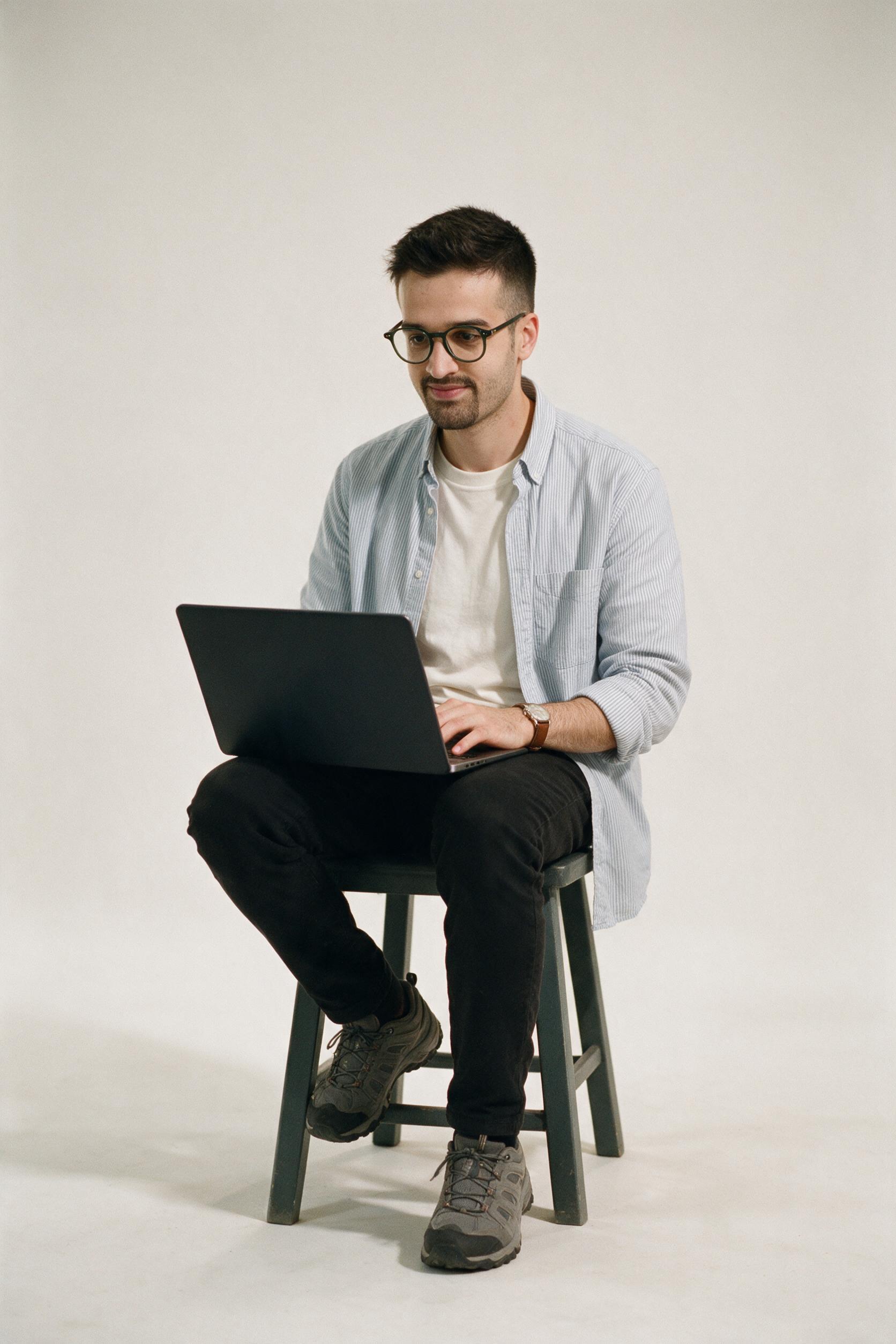 Sitting80%
prompt
The attached photographs are all of ONE REAL MAN. Image 1 is the primary face reference.

Produce a new photograph of that same man. Copy his likeness directly from the attached photographs: the same face, the same head and skull shape, the same hairline, the same beard, the same skin tone and ethnicity, the same build.

This is a photo edit of a real individual. Do NOT design a new character. Do NOT substitute a generic handsome face. Do NOT change his ethnicity. A viewer who knows this man must recognise him instantly.

Change only the scene, the pose, the wardrobe and the light, as specified here:

Framing: Full body, seated on a plain stool with a laptop on his knees, one foot on the rung.
The framing is the final word on what is in frame. Wardrobe items the crop cannot reach — shoes, trousers, a watch — are simply out of shot. Do NOT widen the shot to include them.
Scene: A plain seamless off-white studio backdrop with a soft floor shadow. Nothing else in frame.
Wardrobe: Open light-blue pinstripe oxford shirt over a plain cream crew-neck tee, slim black chinos, a brown leather-strap watch on the left wrist, grey trail sneakers. The oxford sleeves are rolled to just below the elbow in every panel, never worn long and never buttoned at the cuff.
Expression: Absorbed in the screen.
Light: Even, soft, neutral studio light from the front and both sides. Flat and honest, built for design inspection rather than drama.

Photographic style: Candid documentary photography. A full-frame camera with a 35 mm or 50 mm prime at f/2.0. Natural or soft window light. Believable skin texture with visible pores. Slight natural grain. Honest colour.
Avoid: Stock-photo staging. Studio beauty retouching. HDR. Heavy bokeh swirl. Teal-and-orange grading. Fisheye. Motion blur. Text, captions, watermarks or logos anywhere in the frame. Extra people unless the shot asks for them.

## CHECK YOUR OUTPUT AGAINST THE PHOTOGRAPHS
Before you finish, compare the face you have drawn with the attached photographs. These traits are the ones that drift. Each one must match the photographs:

- tall forehead, about 35% of face height, high hairline with a slight recession at each temple  (critical)
- thick full hair on top with real height and body, swept up and back; sides still short and faded  (critical)
- oval face, cheekbone width about 72% of face height, BROAD softly-squared chin with real width, jaw keeping a visible angle, cheeks flat not hollow, face normally fleshed and not gaunt  (critical)
- sparse cheeks with skin showing through, density at the chin and moustache, warmer brown than the hair  (critical)
- tall and lean, shoulders about 2.2 head-widths, slim neck, no bulk  (critical)
- round frames, either thin black metal or thick dark acetate, clear lenses
- straight nose of MEDIUM length and normal size, in proportion to the face, not long and not enlarged
- deep-set dark brown eyes, straight dark brows
- Iranian Persian man, fair to light olive skin, warm undertone, real pores
- early thirties
- one continuous photograph, beard and hairline blend softly into the skin, no pasted-on or cut-out edges
- slim fingers and wrists, only light hair on hands and forearms

If the man you have drawn does not look like the man in the attached photographs, draw the face again from the photographs.
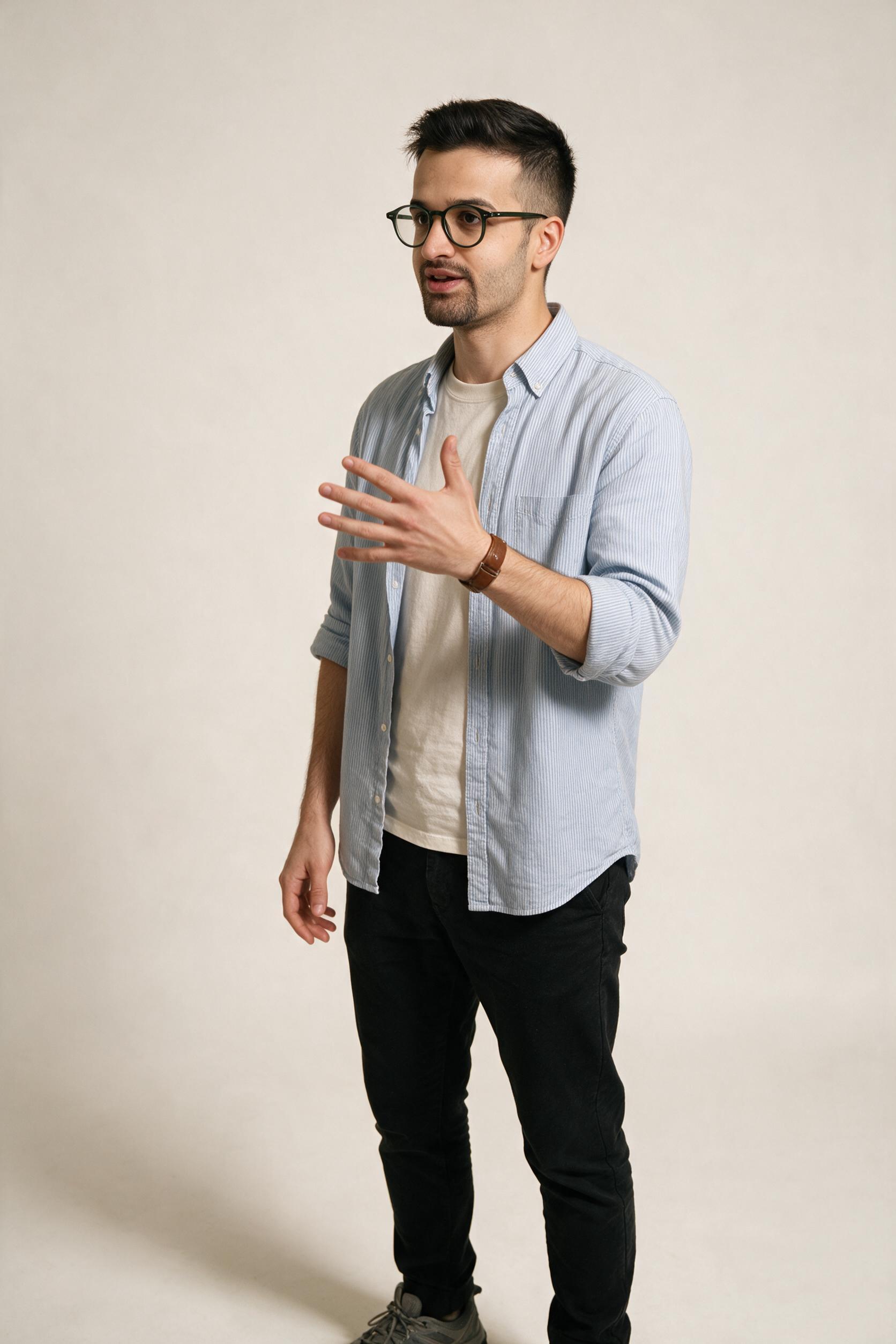 Explaining80%
prompt
The attached photographs are all of ONE REAL MAN. Image 1 is the primary face reference.

Produce a new photograph of that same man. Copy his likeness directly from the attached photographs: the same face, the same head and skull shape, the same hairline, the same beard, the same skin tone and ethnicity, the same build.

This is a photo edit of a real individual. Do NOT design a new character. Do NOT substitute a generic handsome face. Do NOT change his ethnicity. A viewer who knows this man must recognise him instantly.

Change only the scene, the pose, the wardrobe and the light, as specified here:

Framing: Full body, standing, turned to his left, one hand open mid-gesture at chest height.
The framing is the final word on what is in frame. Wardrobe items the crop cannot reach — shoes, trousers, a watch — are simply out of shot. Do NOT widen the shot to include them.
Scene: A plain seamless off-white studio backdrop with a soft floor shadow. Nothing else in frame.
Wardrobe: Open light-blue pinstripe oxford shirt over a plain cream crew-neck tee, slim black chinos, a brown leather-strap watch on the left wrist, grey trail sneakers. The oxford sleeves are rolled to just below the elbow in every panel, never worn long and never buttoned at the cuff.
Expression: Mid-sentence, engaged, talking to someone off camera.
Light: Even, soft, neutral studio light from the front and both sides. Flat and honest, built for design inspection rather than drama.

Photographic style: Candid documentary photography. A full-frame camera with a 35 mm or 50 mm prime at f/2.0. Natural or soft window light. Believable skin texture with visible pores. Slight natural grain. Honest colour.
Avoid: Stock-photo staging. Studio beauty retouching. HDR. Heavy bokeh swirl. Teal-and-orange grading. Fisheye. Motion blur. Text, captions, watermarks or logos anywhere in the frame. Extra people unless the shot asks for them.

## CHECK YOUR OUTPUT AGAINST THE PHOTOGRAPHS
Before you finish, compare the face you have drawn with the attached photographs. These traits are the ones that drift. Each one must match the photographs:

- tall forehead, about 35% of face height, high hairline with a slight recession at each temple  (critical)
- thick full hair on top with real height and body, swept up and back; sides still short and faded  (critical)
- oval face, cheekbone width about 72% of face height, BROAD softly-squared chin with real width, jaw keeping a visible angle, cheeks flat not hollow, face normally fleshed and not gaunt  (critical)
- sparse cheeks with skin showing through, density at the chin and moustache, warmer brown than the hair  (critical)
- tall and lean, shoulders about 2.2 head-widths, slim neck, no bulk  (critical)
- round frames, either thin black metal or thick dark acetate, clear lenses
- straight nose of MEDIUM length and normal size, in proportion to the face, not long and not enlarged
- deep-set dark brown eyes, straight dark brows
- Iranian Persian man, fair to light olive skin, warm undertone, real pores
- early thirties
- one continuous photograph, beard and hairline blend softly into the skin, no pasted-on or cut-out edges
- slim fingers and wrists, only light hair on hands and forearms

If the man you have drawn does not look like the man in the attached photographs, draw the face again from the photographs.
components support the work
accessible by default
do
- Use ink for every text treatment on yellow.
- Keep keyboard focus visible with the ember ring.
- Write useful alt text for meaningful images.
- Keep body copy between 65 and 75 characters wide.
- Show complete content when reduced motion is active.
don’t
- Use white text on yellow or yellow text on cream.
- Hide readable content behind opacity animation.
- Add gradients, glows, or decorative glass.
- Use monospace to appear technical.
- Mix old visual directions into this system.